


News
2027 Global Fastener Market Outlook Report


Add to my favorite
2026-10-02
The Industry Enters a “Repositioning Phase” —
Demand Shifts, Trade Restructuring and the New Competitive Landscape for 2027
A screw may look like one of the most insignificant components in manufacturing, yet it is also a highly sensitive “thermometer” for global manufacturing conditions and supply-chain changes. When an automotive plant adds a production line, housing starts recover, energy equipment investment increases, semiconductor equipment capacity expands, or a data center is enlarged, each development can ultimately translate into batches of fastener demand. Therefore, when the global fastener market in 2026 presents a complex picture—some markets grow while others decline, some countries increase exports while others lose orders, and some products gain both volume and price while others can compete only on price—it does not mean global fastener demand is disappearing. What is really happening is a redistribution of global fastener demand.
The globalized supply chain built over the past 20-plus years has been centered on large-scale manufacturing in China, specialized exports from Taiwan, high-value demand in Europe and the U.S., and precision manufacturing in Japan. It is now being joined by new production and consumption nodes in India, ASEAN, Mexico, the Middle East and Latin America. Another change has emerged in 2026: the basis for fastener competition is gradually shifting from “who can make it cheap” toward “who can give customers confidence in long-term use.” Price, quality and lead time still matter, but origin, supply-chain resilience, carbon data, product traceability, special materials, engineering capabilities and local service are becoming increasingly important. If the global fastener market was once a “capacity race,” the theme after 2026 is those who can find new demand, enter new supply chains and deliver greater product value will have opportunities to secure a position in the next market reshuffle.
First Look at Global Manufacturing: Fastener Demand Has Not Disappeared—It Has Developed “Gaps”
Fastener market conditions must be viewed together with downstream industries. In terms of vehicle sales, according to OICA, global new-vehicle sales in 2025 had moved beyond the sharp volatility of the pandemic period, but recovery varied by region. Europe, for example, registered about 18.63 million new vehicles of all types in 2025, still below the 20.93 million recorded in 2019; the EU-27 plus EFTA and the UK registered about 15.51 million, approximately 16% below the 18.42 million recorded in 2019. This suggests that automotive fastener demand in traditional mature markets, even without a collapse, may not return to the rapid expansion seen in the past.
At the other end, new sources of demand are emerging. EVs, renewable energy, AI servers, data centers, semiconductor equipment, automation, robotics, aerospace, drones and defense-related manufacturing, as well as infrastructure projects promoted by governments, all require large quantities of mechanical structural and joining components. The groundbreaking in September 2026 for the Kaohsiung Baipu Advanced Packaging Industrial Park in southern Taiwan is a typical example. The Kaohsiung City Government stated that expansion of the semiconductor cluster would not only mean investment in wafer, packaging and equipment industries, but would also drive demand for surrounding precision machinery, equipment components and high-end fasteners. The market can therefore no longer be understood through the simple formula “automotive and construction conditions = fastener conditions.” A more precise framework is: traditional demand + emerging manufacturing demand + supply-chain relocation demand = the next stage of the global fastener market.
China: Exports Are Still Growing, but Growth No Longer Means “Low-Price Expansion”
China is a key to understanding changes in the global fastener market. Figure 1 shows exports rising from about US$9.09 billion in 2021 to approximately US$10.04 billion in 2025. In January–July 2026, China's fastener exports were about US$6.184 billion, up approximately 6% year on year. Looking only at the numbers makes it easy to conclude that China's fastener exports are recovering. More important, however, is the simultaneous change in “volume” and “price.”
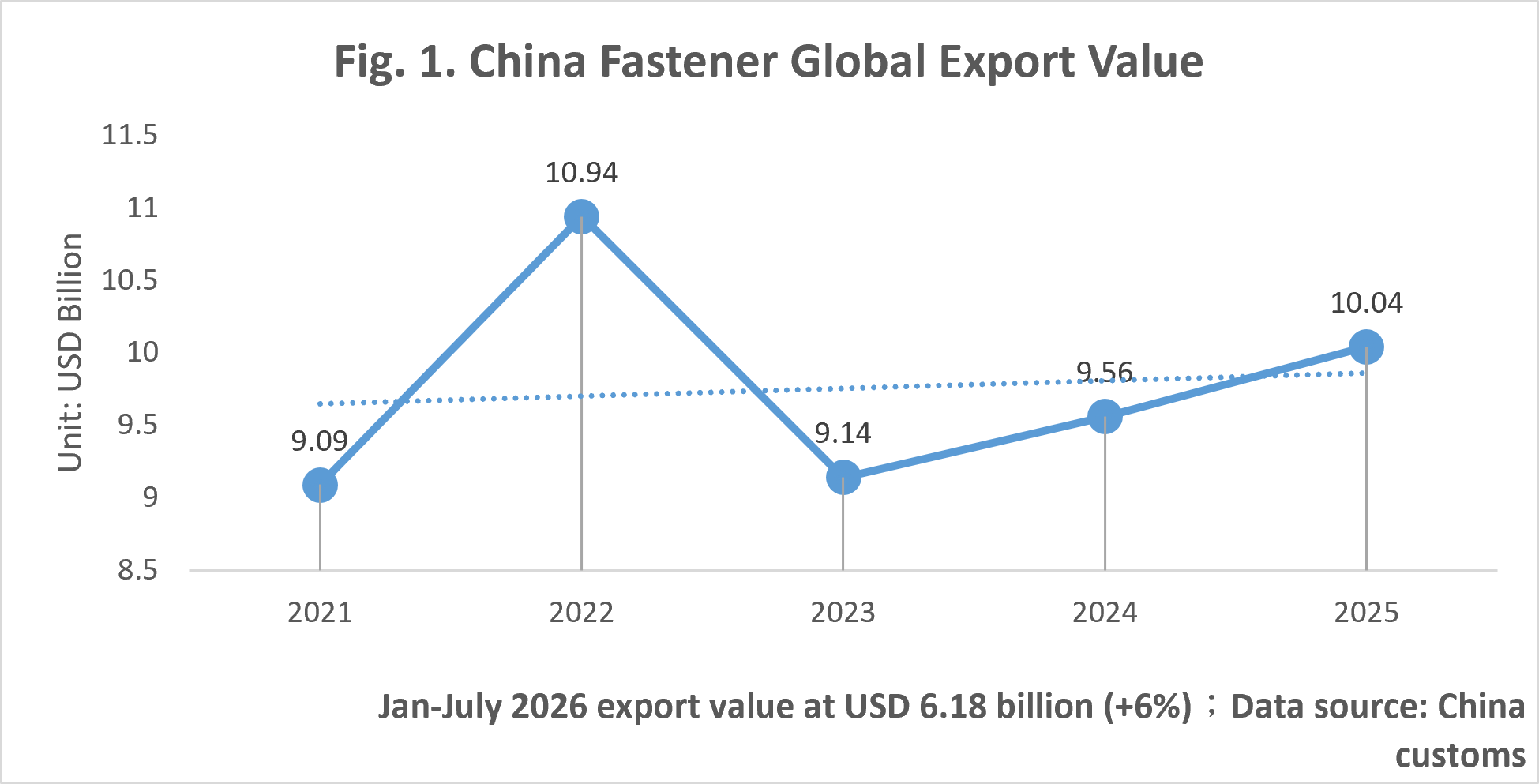
Data from the Taiwan Industrial Fasteners Institute show that China's average fastener export price in January–July 2026 was approximately US$1.99/kg, compared with about US$3.68/kg for Taiwan. In other words, China’s export weight of 3.3033 million tons was about 5 times Taiwan's 665,700 tons, while Taiwan's average unit price was about 1.85 times China's. This comparison shows that China's fastener exports are not increasing revenue simply by selling more tons; product mix and unit prices are also changing.
Chinese customs data show that exports of high-strength screws and bolts rated above 800 MPa increased 13.5% year on year in the first half of 2026, indicating a new growth path for China’s fastener industry: from “globalized capacity” toward “higher product value.” This does not mean competition in low-priced standard fasteners has ended. China’s vast steel supply, tooling, heat treatment, electroplating, surface treatment and complete manufacturing chain remain advantages that other countries would find difficult to replicate in the short term. The market is asking Chinese suppliers a different question: beyond being cheap, what else can you provide?
China's Export Markets Becoming More “Multipolar”: the U.S. Remains Important, but Is No Longer the Only Answer
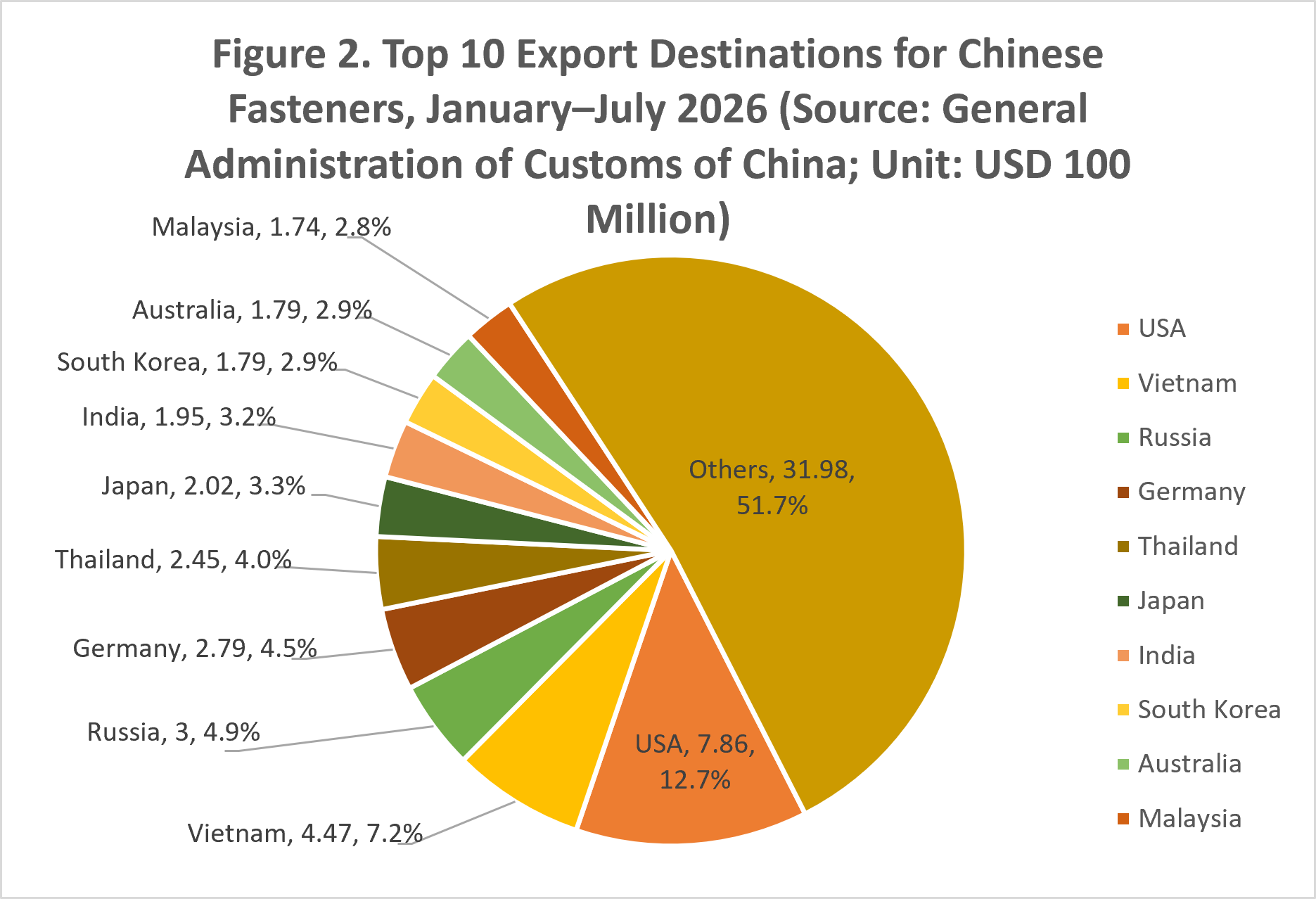
Figure 2 shows that during January–July, the U.S. accounted for only about 12.7% of China's fastener exports, while the EU plus the UK accounted for about 18.5%. By contrast, the 10 ASEAN countries plus Japan, South Korea and India accounted for as much as 28.8%, while other markets represented about 40.0%. In other words, Chinese fastener exporters are not simply dependent on the U.S. market; they are moving with manufacturing, creating a multi-core export structure spanning Asia, Europe, the Americas and other emerging markets. What is more likely to emerge is a layered combination of “China manufacturing + ASEAN assembly,” “China manufacturing + India manufacturing,” “China manufacturing + Mexico localization,” and “Chinese companies establishing overseas plants”. This is at the core of the global fastener supply chain’s move toward multiple production bases.
Taiwan: Total Export Volume Is Under Pressure, but the High-Unit-Value Advantage Deserves More Attention
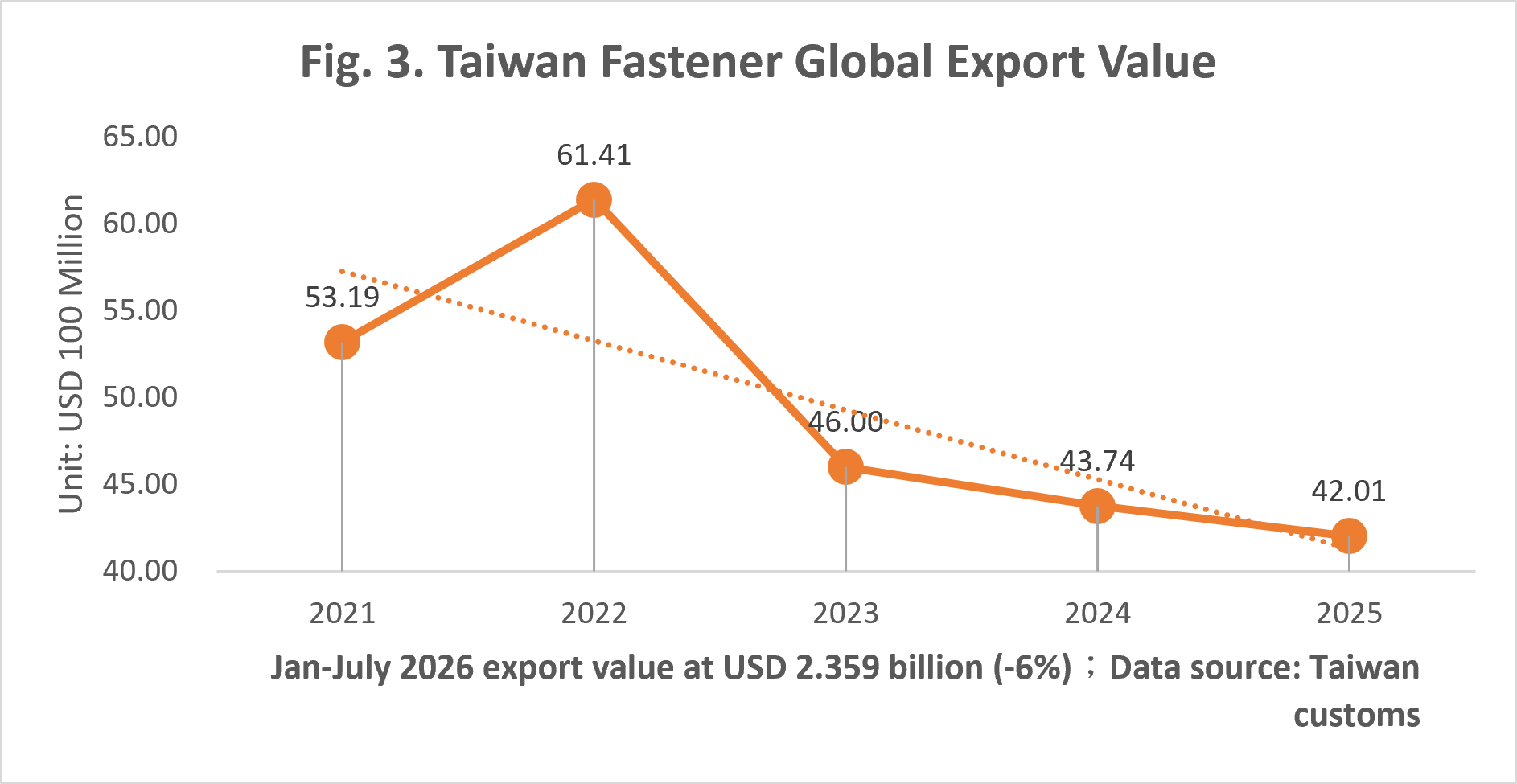
If China represents “scale,” Taiwan represents another model of global fastener competition. According to this analysis, Taiwan's fastener exports (Figure 3) fell from US$5.319 billion in 2021 and US$6.141 billion in 2022 to US$4.600 billion in 2023, US$4.374 billion in 2024 and US$4.201 billion in 2025. Exports were approximately US$2.359 billion in January–July 2026. In terms of total value, Taiwan is clearly under pressure. But the picture changes significantly when export value is viewed together with weight.
As noted above, Taiwan's average unit price is about 1.85 times China's. The real strengths of Taiwan’s fastener industry lie in its large volume of mid- to high-end products, automotive fasteners, special specifications, customized products and long-term OEM supply capabilities. This is why Taiwanese companies can come under pressure when the global market enters price competition; but when customers require higher strength and precision, stricter PPAP, material traceability, IMDS data, carbon data, customized design, stable delivery and multi-year cooperation, Taiwanese suppliers have stronger entry conditions. Taiwan’s fastener industry has also clearly identified EVs, renewable energy, smart manufacturing, aerospace, semiconductor equipment and automation as high-value application directions, and views competition as shifting from price and scale toward technology, application expertise and brand value. The key issue for Taiwan is therefore not whether its products are competitive, but whether high-value products can enter more markets.
Taiwan's Biggest Structural Risk: Not China, but “Market Concentration”
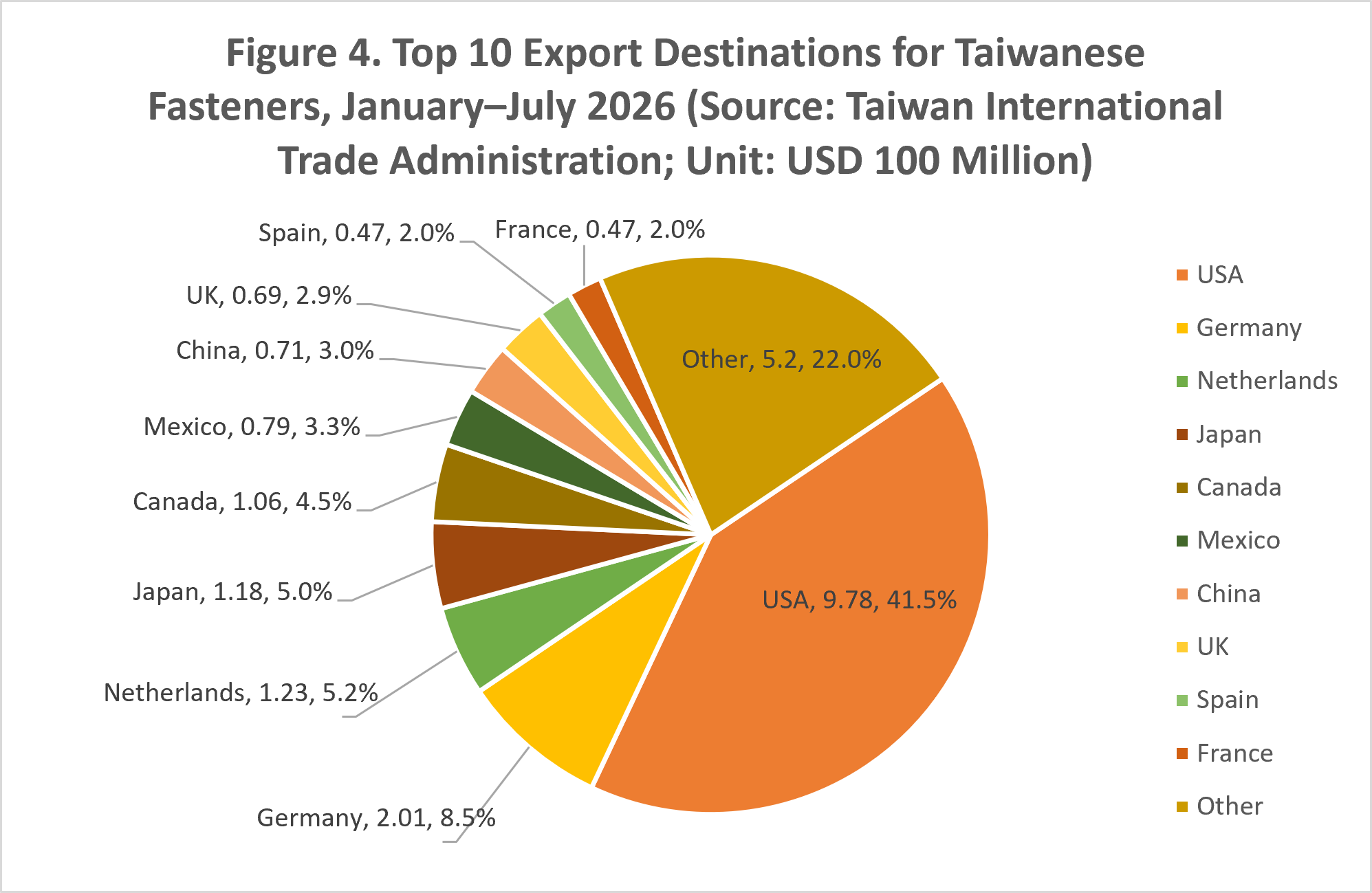
One of the most notable figures in Taiwan's fastener exports is the U.S. market share. Figure 4 shows that in January–July 2026, Taiwan's fastener exports to the U.S. were about US$978 million, accounting for approximately 41.5% of total global exports during the same period. This means Taiwan's global fastener footprint remains highly dependent on North American demand. This structure can be advantageous in a strong market because the U.S. market is large, product unit values are relatively high, and customer quality requirements fit Taiwanese capabilities. But when U.S. import policies, tariffs, inventory cycles or sourcing patterns change, Taiwan's exports can be disproportionately affected. The U.S. should remain a core market, but it can no longer be the only core market; "market diversification" is a crucial task facing Taiwan's fastener industry. For Taiwan, true market diversification does not mean selling just a small amount to every country, but rather gradually establishing second, third, and fourth markets comparable in importance to the U.S.
U.S. Demand Has Not Disappeared, but Procurement Logic Is Changing
The U.S. is a key end-demand center to watch in the global fastener market. Figure 5 shows that U.S. imports of fasteners rose from US$6.028 billion in 2021 to US$7.718 billion in 2022; they fell to US$6.308 billion in 2023, reached US$6.598 billion in 2024, and declined again to US$6.011 billion in 2025. In January–July 2026, U.S. fastener imports were approximately US$3.307 billion, down about 10.7% from US$3.705 billion in the same period of 2025.
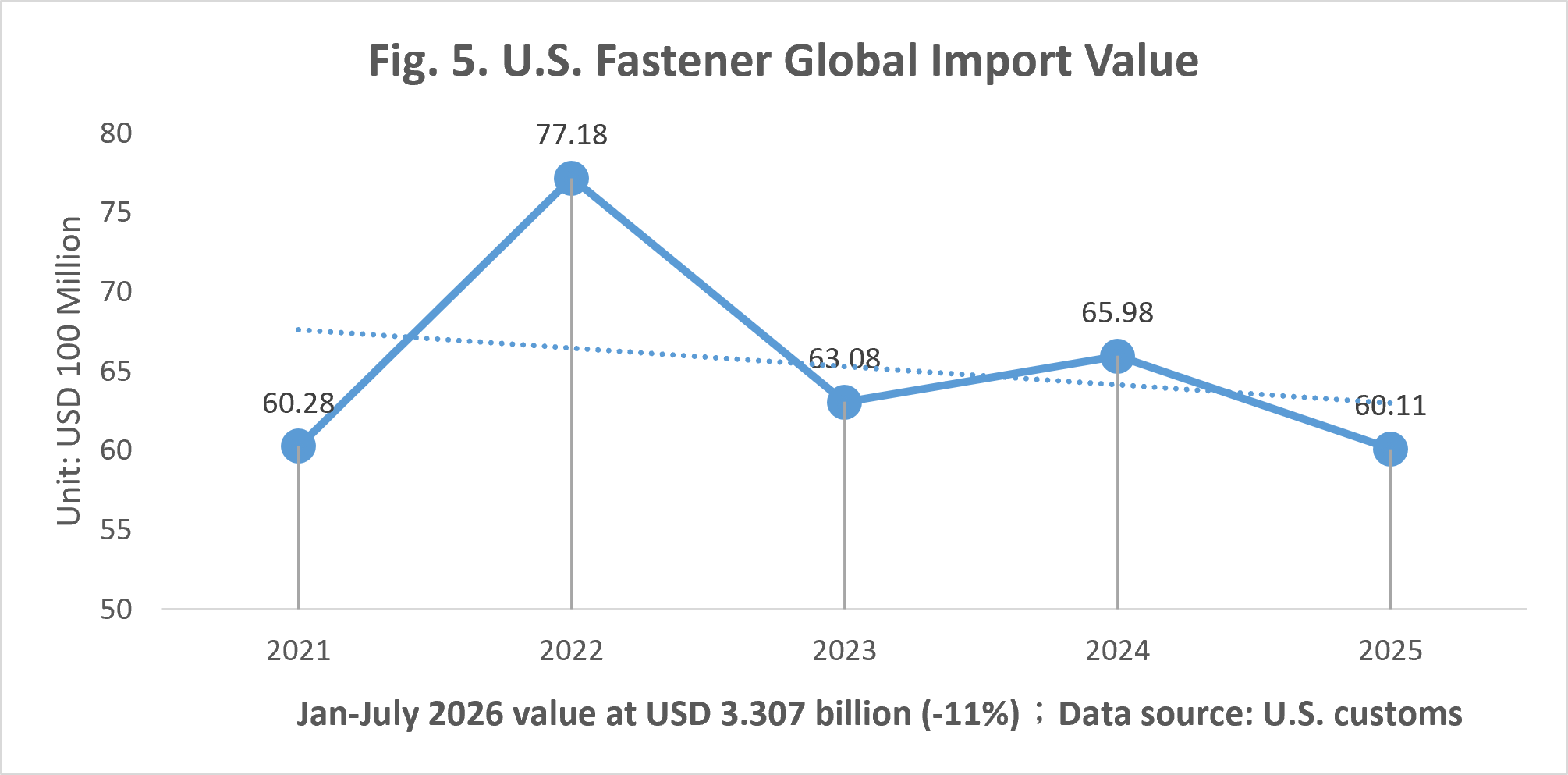
On the surface, U.S. import demand appears to be cooling, but the Fastener Distributor Index (FDI) provides another signal. The FDI stood at 58.3 in August 2026, down from 59.9 in July, but remained above 50 for the 16th consecutive month and above 55 for the sixth consecutive month; its forward-looking indicator was 56.9, also indicating continued expansion. U.S. fastener import volume is contracting, but this does not mean all end demand is disappearing proportionally. For the U.S. market, the key issue is not simply “how much is imported,” but how inventory drawdown, sourcing, domestic manufacturing and end-market demand rebalance. The future keyword for the U.S. market is therefore not simply “growth,” but “procurement flexibility”: U.S. customers may simultaneously require Asian, North American and Mexican suppliers, additional sources, safety stock, local warehousing and fast delivery.
Mexico: An Important Node for Entering the North American Fastener Supply Chain
U.S. export data reveal the importance of Mexico. In 2025, U.S. fastener exports were approximately US$5.663 billion, including about US$1.857 billion to Mexico and US$1.313 billion to Canada; together, the two markets accounted for more than half. In January–July 2026, U.S. fastener exports to Mexico were about US$1.111 billion, compared with US$745 million to Canada. This indicates that the North American fastener market is in fact a highly integrated regional supply chain. For suppliers, the question is therefore not simply “Should we enter the U.S.?” but “Through which North American node should we enter the supply chain?” If Mexico continues to serve as a manufacturing and assembly center, models such as “Asia → local processing/warehousing in Mexico → North America” or “Taiwan/China/Japan → Mexico → U.S.” may become important business models after supply-chain restructuring.
Europe: Redefining the “Cost of Fasteners”
Cross-referencing import value and weight shows that EU fastener imports from non-EU countries increased from about 1.854 million tons in 2021 to 2.033 million tons in 2022; by 2025, the weight had recovered to 1.832 million tons, while import value rose to €6.58 billion. However, the average import price in 2025 had fallen to about €3.59/kg, below the levels in 2022 and 2023. In other words, EU fastener imports in 2022 were characterized by “weight rising less than price” — weight increased only about 10%, while value jumped 35%. In 2025, the pattern reversed: import weight recovered 11%, but value increased only 5.5%, indicating that the EU is gradually moving from the high-price, high-inventory environment of previous years toward a more normal procurement structure.
The special feature of the European market is that it is redefining “product cost.” A traditional fastener quotation consists of material, processing, surface treatment, packaging, transportation, and profit. The future European procurement cost model adds carbon emissions + verification + origin + regulatory compliance. The European Fastener Distributor Association noted in its 2026 industry observations that the European fastener distribution sector is facing cost pressures from China-related anti-dumping measures and CBAM; anti-dumping duties on certain Chinese non-headed screws and threaded rods are substantial, while CBAM further increases the cost and administrative burden of imported fasteners. Suppose an M8 bolt is quoted at US$100 by Supplier A and US$103 by Supplier B, but Supplier B can provide complete carbon-footprint data, material origin, process records and verification documents. Under traditional procurement logic, A is cheaper. Under the new European supply-chain logic, B is not necessarily more expensive, because customers are comparing total cost of ownership (TCO), not simply the purchase price. This is the new battleground for the global fastener industry.
Japan's Export Value Has Declined, but Its Role in “High-Value Manufacturing” Remains
Figure 6 shows that Japan's fastener exports were approximately US$2.924 billion in 2021, falling to US$2.560 billion in 2022, about US$2.373 billion in 2023, US$2.305 billion in 2024 and US$2.303 billion in 2025. Export weight declined from 343,400 tons in 2021 to 286,200 tons in 2025.
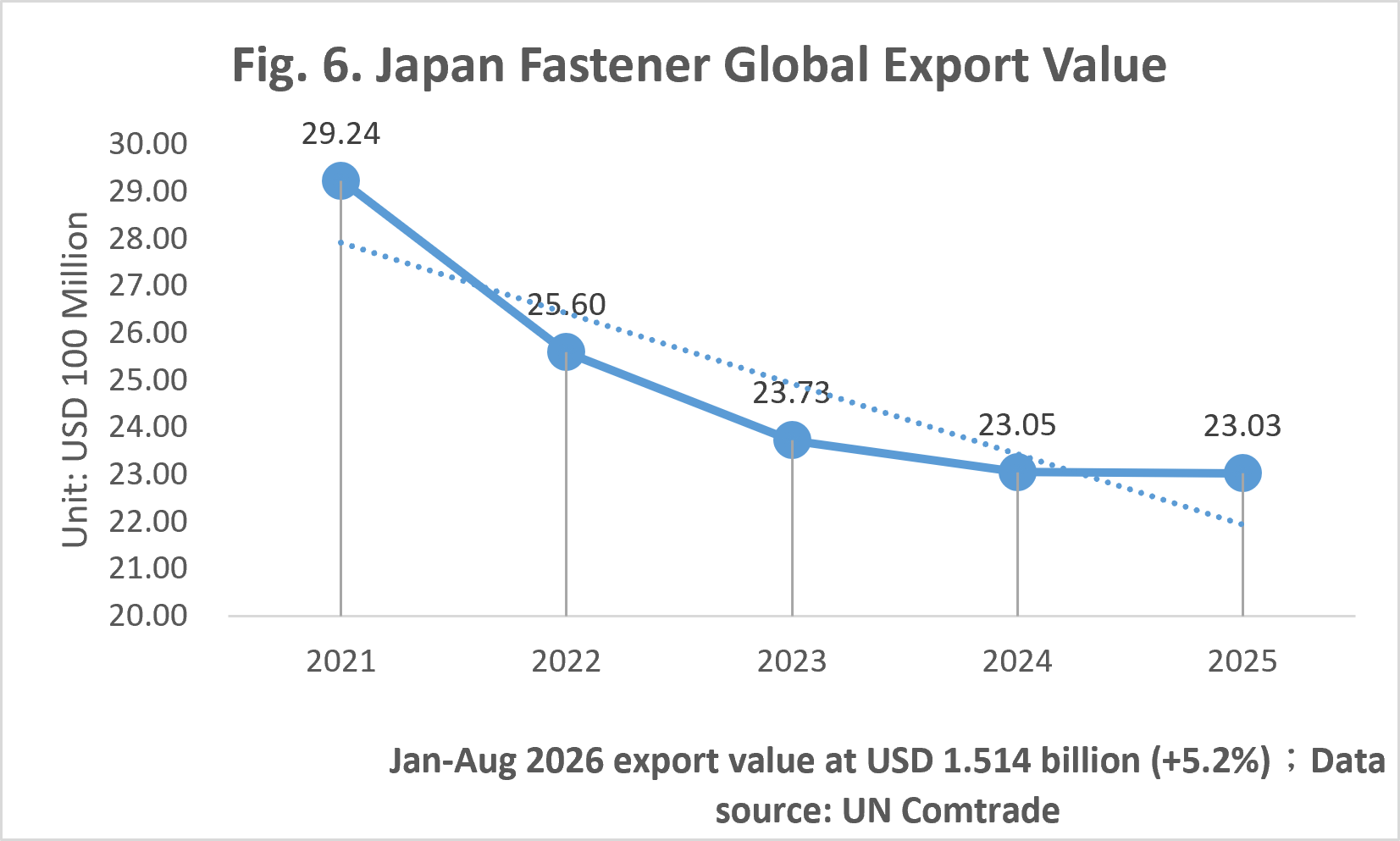
Although Japan's export weight has declined, export value has not fallen by the same proportion, indicating that Japan continues to retain significant product value. Japan's competitive fields include automotive, precision machinery, industrial equipment, electronics, high-reliability components, special materials and high-precision processing. In these fields, the required fastener is not necessarily the “cheapest,” but the “right fit.” Japan and Taiwan also have a degree of complementarity and competition. China can enter through scale, while Japan and Taiwan are more likely to compete in high-precision, high-reliability and customized products.
India Gradually Shifts from a “Market” to a “Manufacturing Base”
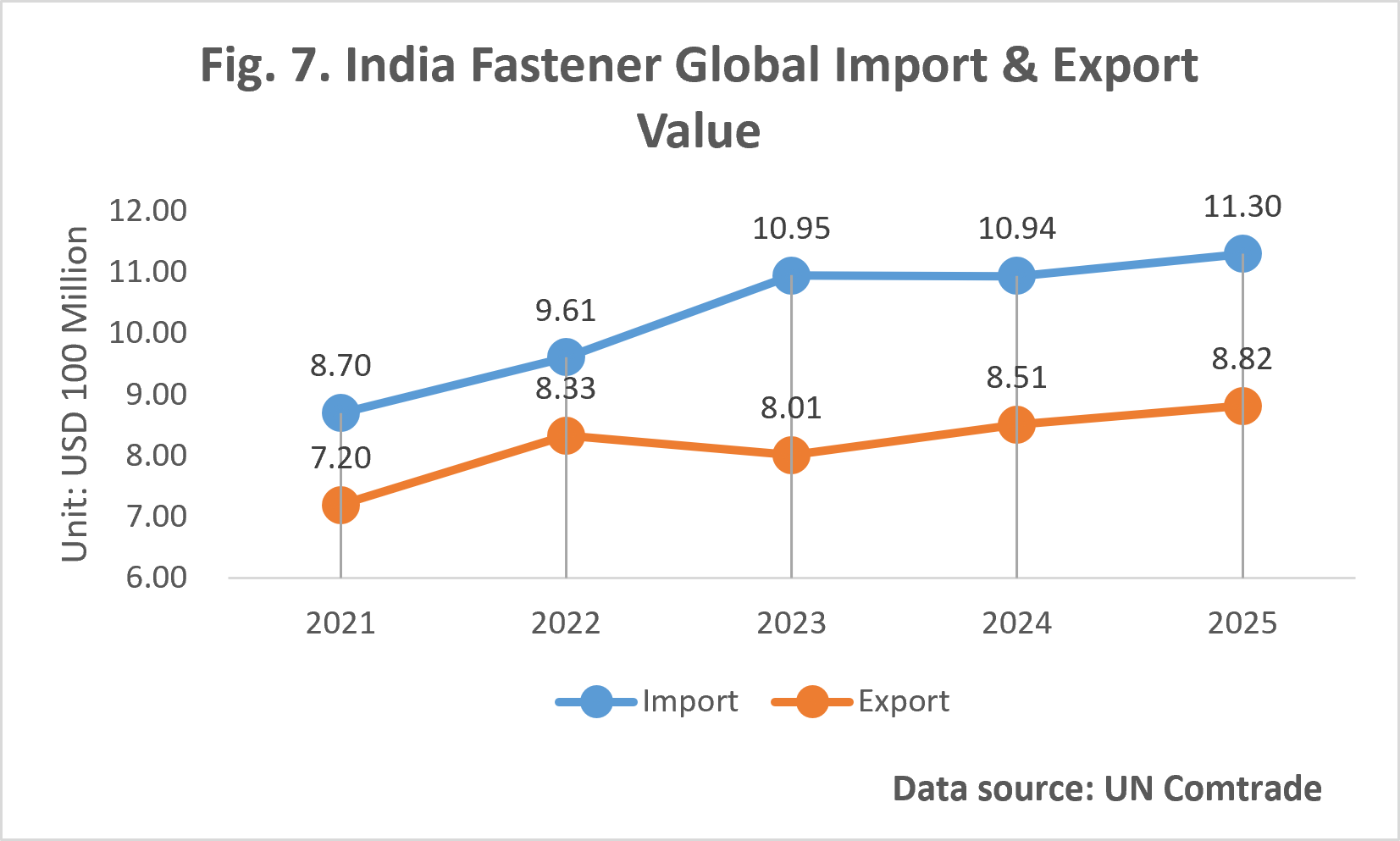
The UN Comtrade Database (Figure 7) shows that India's fastener imports rose from approximately US$870 million in 2021 to US$1.130 billion in 2025, while exports increased from US$720 million to US$882 million, indicating that India is developing both a “demand market + production base.” India's distinctive feature is that its population scale, automotive manufacturing, railways, energy, electronics, defense, machinery and infrastructure can all generate demand. Once multinational manufacturers place more production capacity in India, fasteners can shift from general industrial consumables to important components in localized supply chains.
This creates two opportunities. The first is direct exports; the second is collaboration with Indian suppliers through partnerships, technology licensing, processing, warehousing and even joint-venture production. For Taiwanese and other international companies, the future Indian market may not simply be about “selling products there,” but about bringing their manufacturing capabilities into India.
ASEAN's Real Value Lies Not Only in Consumption, but in “Supply Chain Relocation”
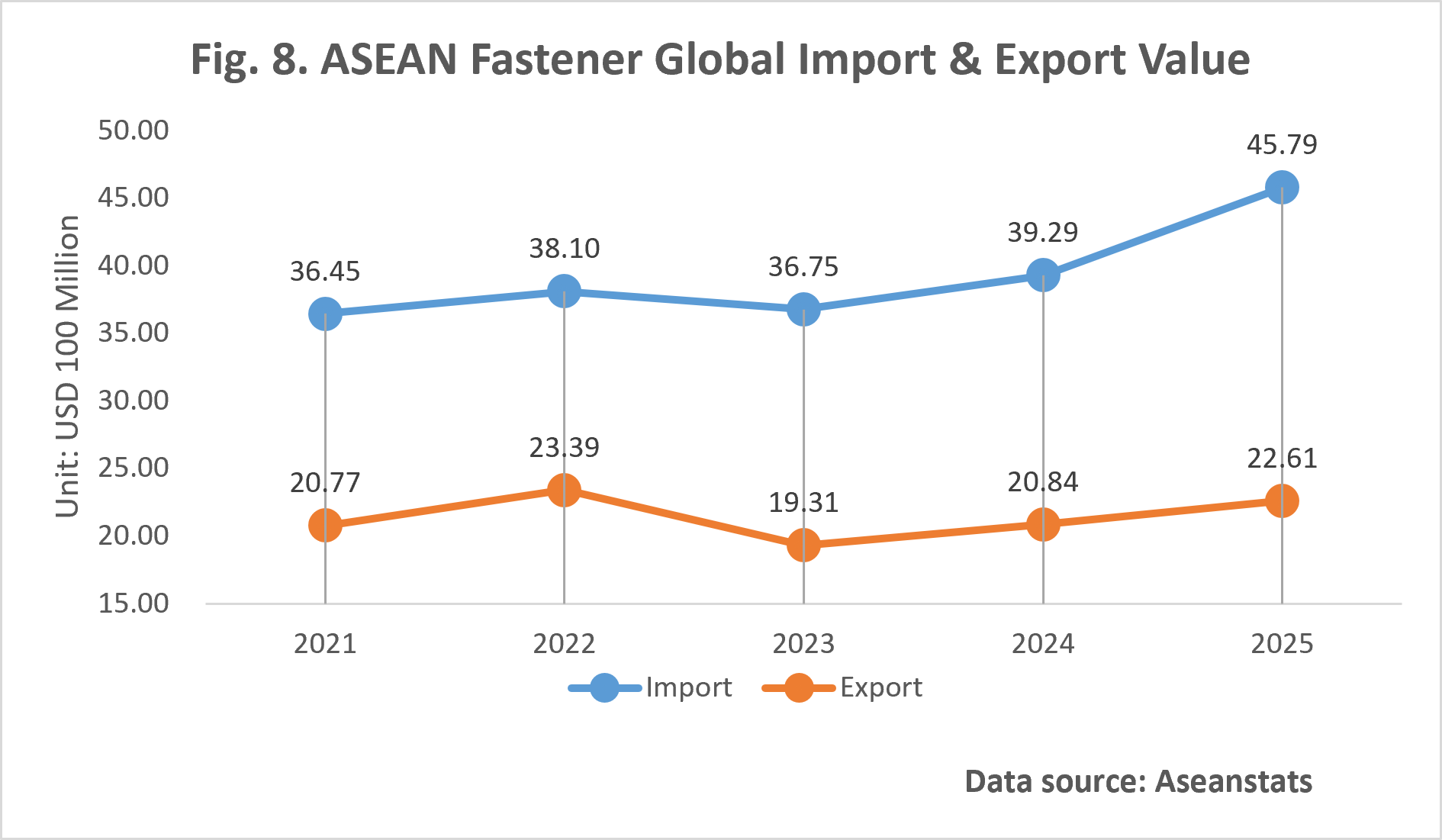
Figure 8 shows that from 2021 to 2025, ASEAN fastener imports from the world increased from US$3.645 billion to US$4.579 billion, up about 25.6%, with 2025 marking a particularly clear growth point. Exports rose from US$2.077 billion to US$2.261 billion, up only about 8.9%. This indicates that regional fastener demand expanded rapidly as post-pandemic supply-chain restructuring and manufacturing investment accelerated. More importantly, demand is not evenly distributed; it is concentrated in countries such as Vietnam, Thailand, Indonesia and Malaysia, which have automotive, electronics, machinery and assembly manufacturing capabilities—all industries that require large quantities of fasteners. This signifies a shift in ASEAN’s role: it is no longer merely a consumer market for fasteners but is increasingly becoming a "production node" integrated into the manufacturing supply chains of China, Japan, South Korea, and other parts of Asia. The growth of ASEAN and surrounding Asian markets represents more than just rising demand; it reflects a structural shift in demand driven by the reconfiguration of global manufacturing bases.
Brazil and Latin America: An “Underestimated Regional Demand Center”
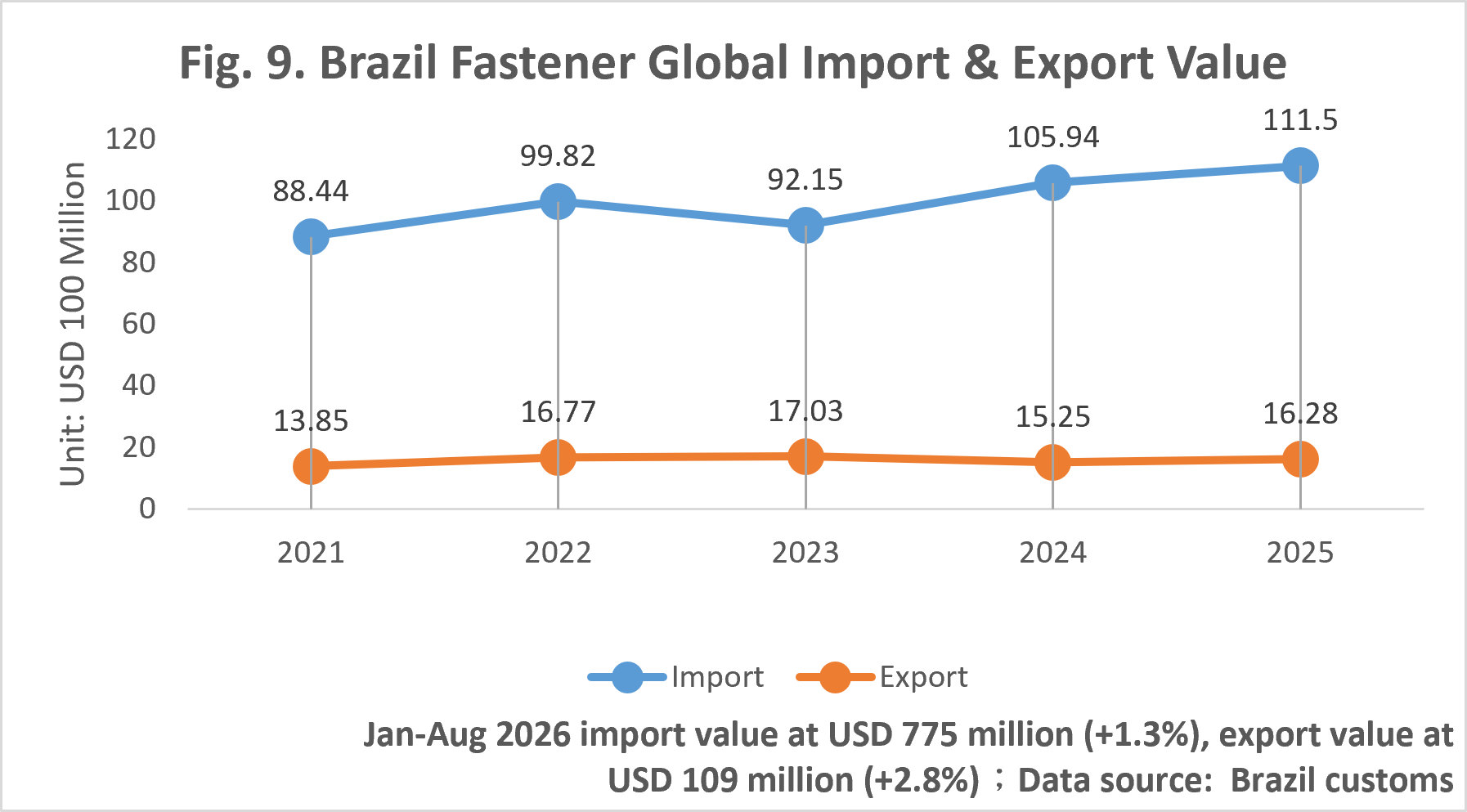
In 2025, Brazil imported about US$310 million of fasteners from China, rising to about US$230 million in January–August 2026; imports from the U.S. were US$181 million in 2025 and about US$128 million in January–August 2026. Viewed by supply source, China has long ranked first, accounting for about 27.8% of Brazil's fastener imports in 2025, followed by the U.S., Italy, Germany and Japan. This represents a diversified import structure in which China provides large-volume supply while European, U.S. and Japanese suppliers provide some higher-value products. More importantly, Brazil is not simply a “low-price market.” Automotive, energy, agricultural machinery, mining, construction and infrastructure create diverse industrial fastener demand. Brazil is South America’s largest fastener market: imports grew by nearly 44% from 2021 to 2025 (Figure 9), far exceeding export scale, indicating that market expansion is primarily supported by overseas supply rather than a parallel expansion of domestic fastener capacity. For global suppliers, Brazil also has a special value as a regional gateway into South America and should be viewed as an independent market cluster with its own manufacturing, infrastructure and resource-industry demand.
Australia and the Middle East: Two Different Types of Niche Markets
Australia's Demand Is Stable, but Market Size Is Limited by Population and Industrial Structure
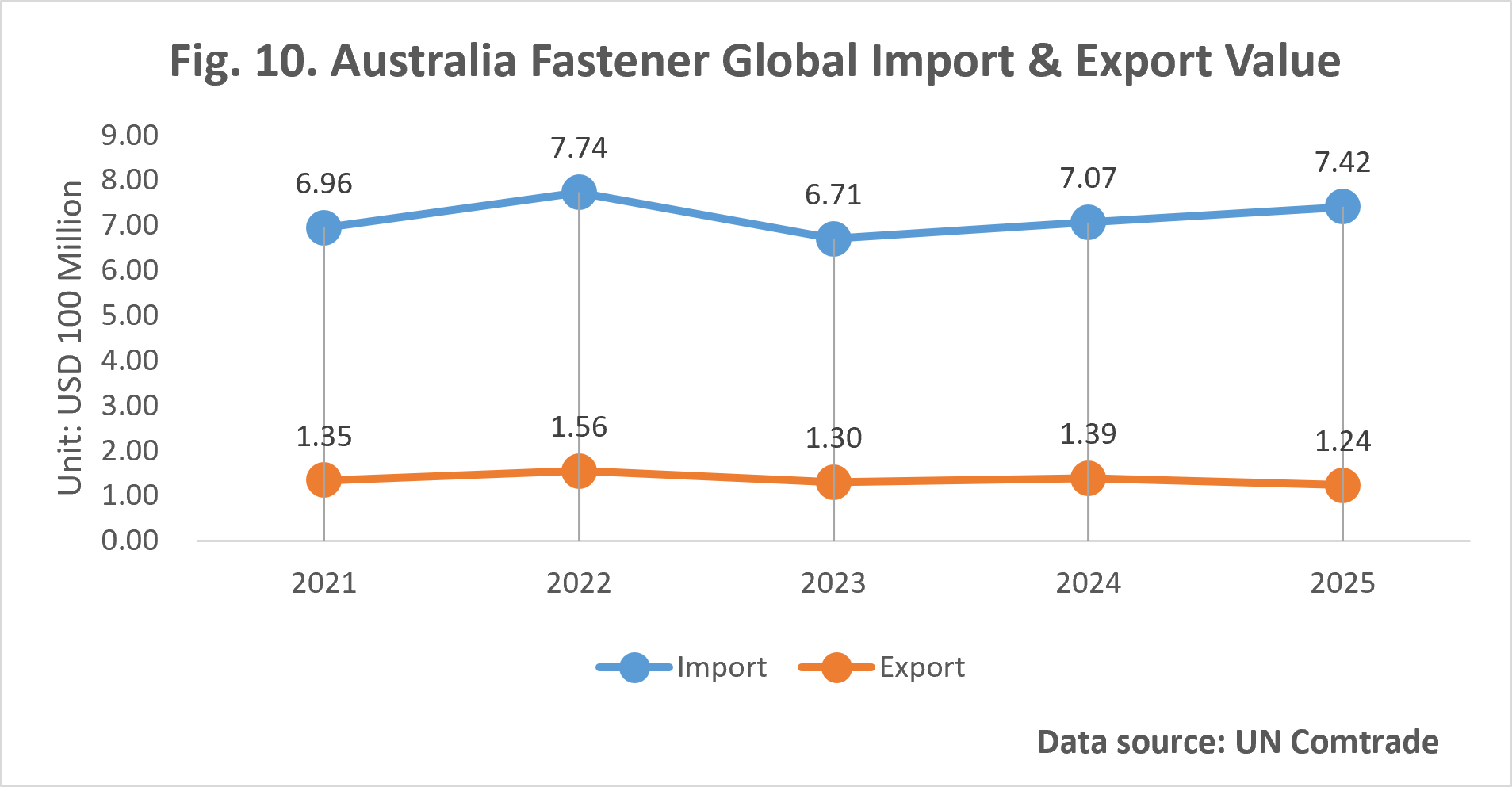
Australia is a typical resource- and infrastructure-driven fastener import market. Fastener imports (Figure 10) rose from US$696 million in 2021 to US$742 million in 2025, while exports remained around US$120–160 million for most of the period, reaching US$124 million in 2025. A large share of Australian fastener demand comes from mining, energy, construction, infrastructure, agricultural machinery and heavy-equipment maintenance. The market is therefore less about large volumes of low-priced standard screws and more about products suitable for outdoor environments, corrosion protection, heavy loads, equipment maintenance and engineering specifications. China has an important position in Australia’s fastener imports. For suppliers, Australia may be better approached through stainless steel, high-strength products, special specifications, engineering certifications and low-volume/high-mix products rather than direct price competition with Chinese suppliers.
Middle Eastern Demand Is More Volatile, but Large Projects Create High-Value Opportunities
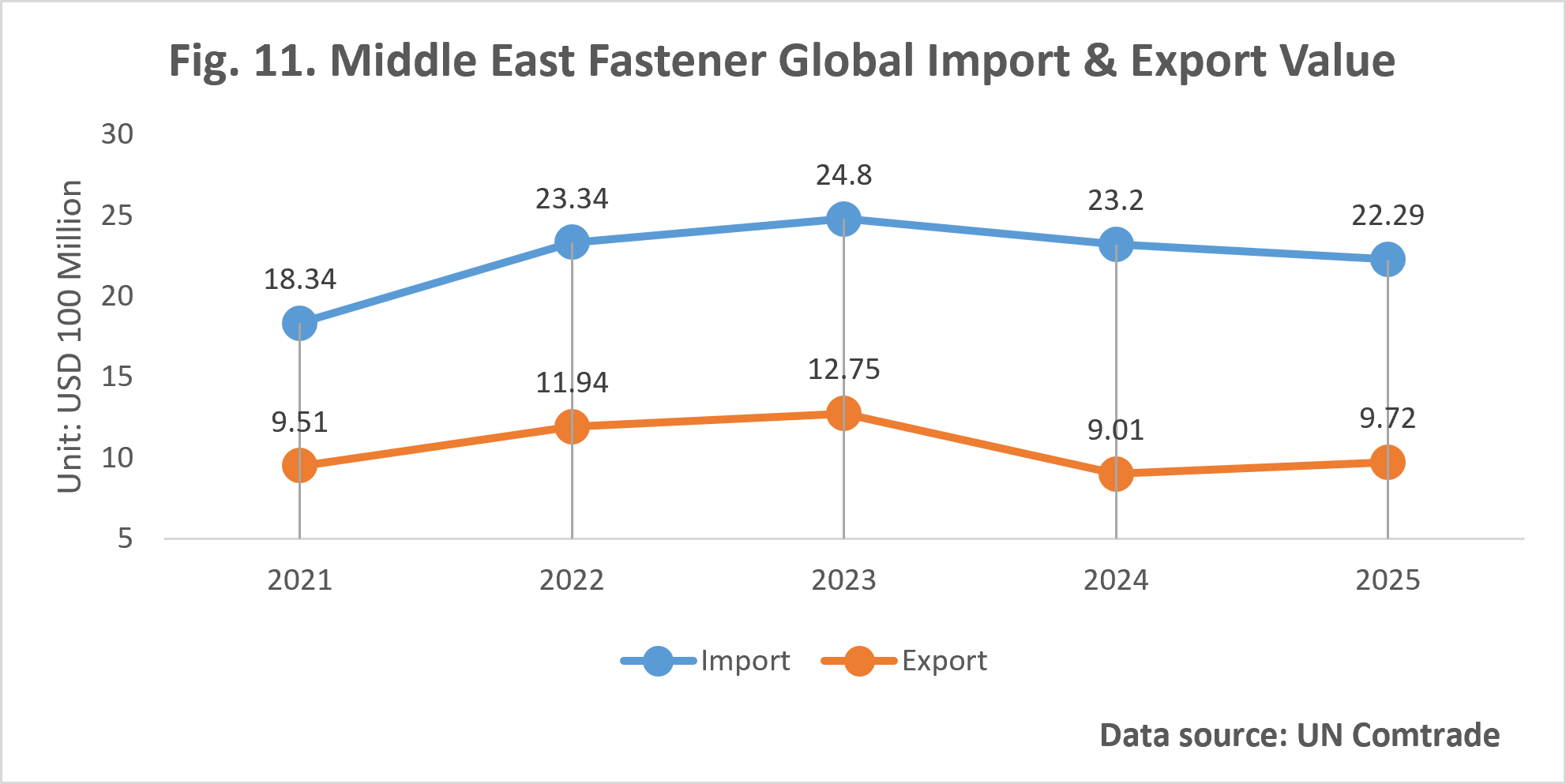
The Middle East is a regional market made up of multiple Gulf countries, the energy industry, infrastructure, petrochemicals, power, transportation and large construction projects. Its fastener imports (Figure 11) were US$1.834 billion in 2021. Although imports declined after 2023, they remained above US$2.2 billion in 2025, indicating that Middle Eastern fastener demand is not entirely dependent on short-term economic conditions and has a deeper structural relationship with major projects, energy equipment and infrastructure investment. The Middle East can therefore be viewed as a “project-driven market” that generates substantial fastener demand and places relatively high requirements on corrosion resistance, high strength, special coatings, specification certification and traceability.
The 2026 Turning Point: From “How Much per Kilogram?” to “How Much Is Each Application Worth?”
The fastener industry has traditionally measured competitiveness through “cost,” but this metric may become increasingly insufficient. A standard M8 bolt and a specialized fastener used in aviation, semiconductor equipment, battery equipment or high-performance machinery may weigh roughly the same yet have completely different commercial values. Fastener companies therefore need to focus not simply on “how to reduce cost per kilogram by 5%,” but on “how to make customers willing to pay 20% more for my product.” That 20% represents a “revaluation of value” driven by integrated solutions covering de-risking, supply chain, compliance and higher value.
Looking ahead to 2027, the global fastener market will show three trends. First, globalization will not disappear, but globalization based on a “single source” will decline. Global companies are unlikely to abandon Asian manufacturing completely because cost, supply-chain completeness, technology and capacity remain major advantages of Asia. However, customers will increasingly favor “Taiwan/China +1,” or even “Taiwan/China +1 + regional suppliers,” and “Asia + Mexico/India/ASEAN,” meaning that fastener companies will need to serve both global and regional supply chains.
Second, high-tech applications will become a new growth curve for the fastener industry. AI itself does not directly consume large quantities of screws, but the data centers, servers, power equipment, cooling systems, energy storage, semiconductor equipment and automation equipment driven by AI all generate fastener demand. Likewise, an EV is not just a battery; it also requires motors, body structures, electronic controls, thermal management, charging equipment, lightweight structures and battery packs, all of which create demand for new types of fasteners. Rather than tracking only the “fastener market,” companies should watch which other industries are increasing investment in manufacturing equipment.
Third, carbon management will shift from a “value-added feature” to an “entry ticket,” with CBAM only the starting point. More customers may require product carbon footprint data, environmental product declarations, material origin, recycled material ratios, energy use, process emissions and supply chain traceability. These requirements will become market-entry thresholds for fastener companies and will ultimately directly affect whether customers purchase.
The Global Fastener Market Enters a “Repositioning Phase”
Looking back at the global fastener market in recent years, a clear pattern emerges. In 2021–2022, global demand was driven by post-pandemic restocking, raw-material prices and manufacturing recovery, causing trade values to rise rapidly. In 2023–2024, the market entered inventory correction, slower demand and price adjustments. By 2025–2026, a new structure began to emerge.
2027
全球
扣件
市場
國際展會
惠達雜誌
匯達實業
外銷媒合
廣告刊登
螺絲五金
五金工具
緊固件
台灣扣件展
印度新德里螺絲展
越南河內螺絲展
墨西哥瓜達拉哈拉螺絲展
美國拉斯維加斯螺絲暨機械設備展
2027美國鳳凰城螺絲暨機械設備展
波蘭克拉科夫螺絲展
義大利米蘭螺絲展
德國司徒加特螺絲展
德國杜塞道夫線材展
Fastener
Hand Tool
Hardware
Component
Fastener World
Wire Dusseldorf
Fastener Fair India
Fastener Fair Vietnam
Fastener Fair Mexico
Fastener Poland
Fastener Fair Italy
IFE
Fastener Fair Global
market
global