



News
2027 Global Hardware Components Market Outlook Report

Add to my favorite
2026-10-01
Demand Shift, Supply Chain Restructuring & New Landscape of Competition for High-Value Products
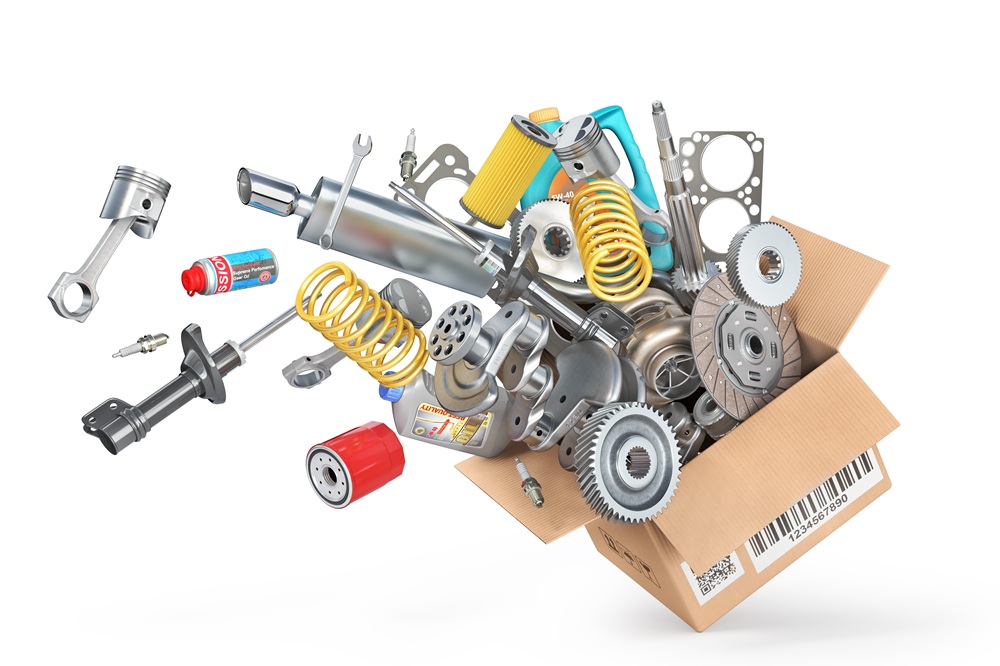
Fasteners are like the “backbone of manufacturing,” while hardware components (Table 1) are like an entire “skeletal system” hidden behind global manufacturing. Springs, steel wire products, hinges, brackets, door and window hardware, furniture hardware, locks, rubber seals, and various mounting and mechanical components may each have a relatively low unit price, yet they are widely used in automobiles, construction, machinery, electronic equipment, data centers, aerospace and energy facilities.
|
Table 1. Scope of “Hardware Component” Defined in this Article
|
||
|
HS Codes
|
Category Title
|
Content
|
|
7320
|
Springs and spring leaves
|
Leaf springs, coil springs and other types of springs.
|
|
7326.2
|
Articles of iron or steel wire
|
Certain wire clips, wire positioning parts and wire fasteners used for fixing applications.
|
|
8302
|
Metal fittings and brackets for furniture, doors/windows, vehicle bodies, etc.
|
Hinges, casters, vehicle fittings, architectural fittings, furniture fittings, brackets and similar products.
|
|
3926.3
|
Plastic fittings for furniture, vehicle bodies, etc.
|
Plastic furniture fittings, vehicle fittings and similar assembly components; may include certain plastic fixing and mounting parts.
|
|
4016.93
|
Rubber gaskets, washers and other sealing products
|
Rubber washers, seals, certain O-rings and other products related to sealing/fixing.
|
|
8301
|
Locks, padlocks and lock-type fasteners
|
Padlocks, vehicle locks, furniture locks, other locks, and fasteners and lock components incorporating locking functions.
|
|
8308.1
|
Base-metal hooks, eyes and eyelets
|
Mainly used for garments, footwear, leather goods and other manufactured products.
|
|
8305
|
Base-metal fittings for loose-leaf binders and files, paper clips and staples
|
Binder/file fittings, paper clips, index tags and strip staples.
|
In its latest September 2026 outlook, OECD projected global GDP growth of 2.9% in 2026 and 3.0% in 2027, indicating that the global economy is not heading into a broad-based recession. The U.S. is projected to grow 2.2% and 2.1% in 2026 and 2027, respectively; the euro area is projected at 1.0% in both years; and China is expected to slow from 4.5% in 2026 to 4.2% in 2027. Meanwhile, AI-related investment remains an important force supporting global production, trade and investment. The key questions for the global hardware components market are: Which industries are investing? Which countries are expanding manufacturing capacity? Which supply chains are moving? From this perspective, the global hardware components market in 2026 is less a broad recovery than a “shift in demand gears.”
Global Hardware Components Demand Is Not Recovering Across the Board—It Is Splitting
The most striking feature of the global economy in 2026 is the widening gap in business conditions across industries. On one hand, parts of Europe’s traditional manufacturing sector continue to face pressure from energy, labor, interest rates and competition. On the other, U.S. investment in AI infrastructure, data centers, aerospace and selected manufacturing industries is emerging as a new pillar of demand.
The automotive industry shows a similar pattern. The Boston Consulting Group's 2026 Global Automotive Supplier Study indicates that global demand for automotive components is still expected to grow over the long term, but the value pool is being redistributed. Batteries, electrical and electronic systems, ADAS, autonomous driving and software-related fields are growing faster, while components associated with traditional internal-combustion powertrains face structural decline. The study also notes that suppliers’ challenges have shifted from the acute post-pandemic crisis to a “new normal” combining interest rates, costs, labor shortages, geopolitical risks and demand volatility.
|
Table 2. Applications of Key Components in EVs
|
||
|
Product Title
|
Main Application on EVs
|
Technical Changes & Challenges in the EV Era
|
|
Springs
|
1. Support for underbody suspension and shock-absorbing systems
2. Gas struts for powered tailgates and front trunks 3. Miniature return mechanisms for interior buttons and storage compartments |
1. Much higher rigidity requirements: heavier battery packs require greater load capacity and fatigue life.
2. Lightweight design: high-strength steel or composite materials are used to reduce vehicle weight and extend driving range. |
|
Brackets
|
1. Mounting and crash-protection structures for heavy battery modules
2. Mounting of powertrain/electrical components such as drive motors and inverters 3. Mounting of onboard radars, cameras and other sensors |
1. Changes in safety and rigidity: battery brackets must provide very high crash-energy absorption and structural protection.
2. Integrated die-casting trend: to reduce part count and weight, many traditional steel brackets are shifting to one-piece aluminum-alloy structures. |
|
Hinges
|
1. Connections for conventional four-door vehicle doors and rear tailgates
2. Opening/closing mechanisms for front trunks 3. Connections for EV charging-port doors |
1. New component demand: conventional vehicles do not have front-trunk or charging-port-door hinges, creating new demand in EVs.
2. Smart and concealed designs: hinge designs must accommodate streamlined bodywork, such as concealed hinges, and electronic/electric opening systems. |
|
Seals
|
1. Waterproofing and dust protection for battery packs, motors and high-voltage electronics
2. Air sealing and sound insulation for doors and windows |
1. Very high water/dust protection: high-voltage battery systems have a high short-circuit risk, requiring seals to meet high standards such as IP67/IP69K.
2. Stricter acoustic requirements: without engine noise, wind and road noise become more noticeable, requiring better sound absorption and air sealing. |
|
Locks
|
1. Electronic security locks for doors and front/rear luggage compartments
2. Anti-pullout electronic locks for charging connectors |
1. Full electronic and digital integration: conventional mechanical locks are shifting to electronically integrated locks supporting phone sensing or concealed handles.
2. Dedicated lock applications: “charging-gun electronic locks” help prevent charging interruption or accidental removal of the charging connector. |
Yet a vehicle does not suddenly stop needing springs, brackets, hinges, seals, locks or other metal components simply because it shifts from an internal-combustion engine to an electric powertrain (Table 2). What is really changing is which components see rising or falling demand, as well as customers’ requirements for performance, materials, reliability and supply. Hardware component companies therefore cannot track only “volume”; they must also track structural changes across industries.
U.S. Demand Is Shifting from “General Manufacturing” to “High Investment Intensity”
According to the UN Comtrade Database (Figure 1), U.S. imports of the 8 hardware component categories selected in Table 1 were approximately US$16.580 billion in 2021, rising to US$18.879 billion in 2022; they fell to US$16.737 billion in 2023, recovered to US$17.679 billion in 2024, and stood at US$16.552 billion in 2025. Over the same period, exports increased from US$6.173 billion in 2021 to US$7.183 billion in 2025. More noteworthy is the change in weight.
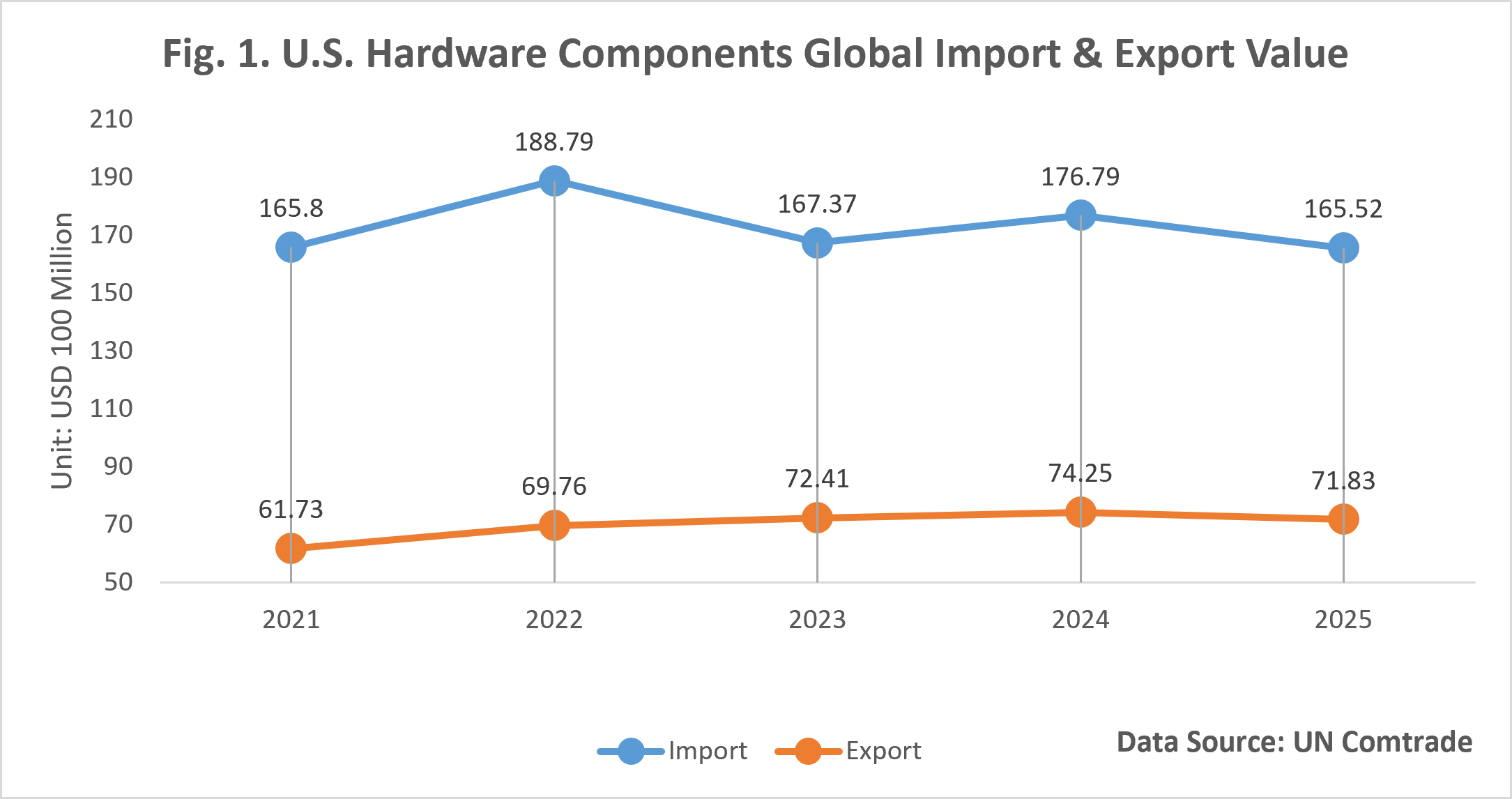
U.S. hardware component import weight rose from approximately 2.682 million tons in 2021 to 2.807 million tons in 2022, fell to 2.325 million tons in 2023, recovered to 2.567 million tons in 2024, and declined again to 2.284 million tons in 2025. In other words, the value of imports in 2025 had broadly returned to the 2021 level, while import weight was below the 2021 level. This indicates that the U.S. market is not growing simply by “buying more weight”; its product mix and unit value are changing.
The U.S. construction market further illustrates this “shift in demand gears.” According to the U.S. Census Bureau and the National Association of Home Builders, U.S. housing starts declined from 1.3671 million units in 2024 to 1.3587 million units in 2025; cumulative starts in January–August 2026 were about 930,000 units, with the full-year total estimated at roughly 1.30–1.35 million units. The housing market has not shown strong expansion, but this cannot be directly interpreted as weak demand for U.S. construction hardware. The American Institute of Architects’ July 2026 construction forecast showed significant divergence within the U.S. nonresidential market: data centers are driving commercial construction investment, while manufacturing construction spending is facing adjustment. In other words, weak traditional construction demand does not mean all construction hardware demand is weak; demand is shifting toward data centers, energy, infrastructure and high-tech manufacturing facilities. For suppliers, the implication is clear: in the U.S. hardware components market, market position may matter more than the overall market size.
China's Role as the Global Manufacturing Base Remains, but Its Demand Structure Is Changing
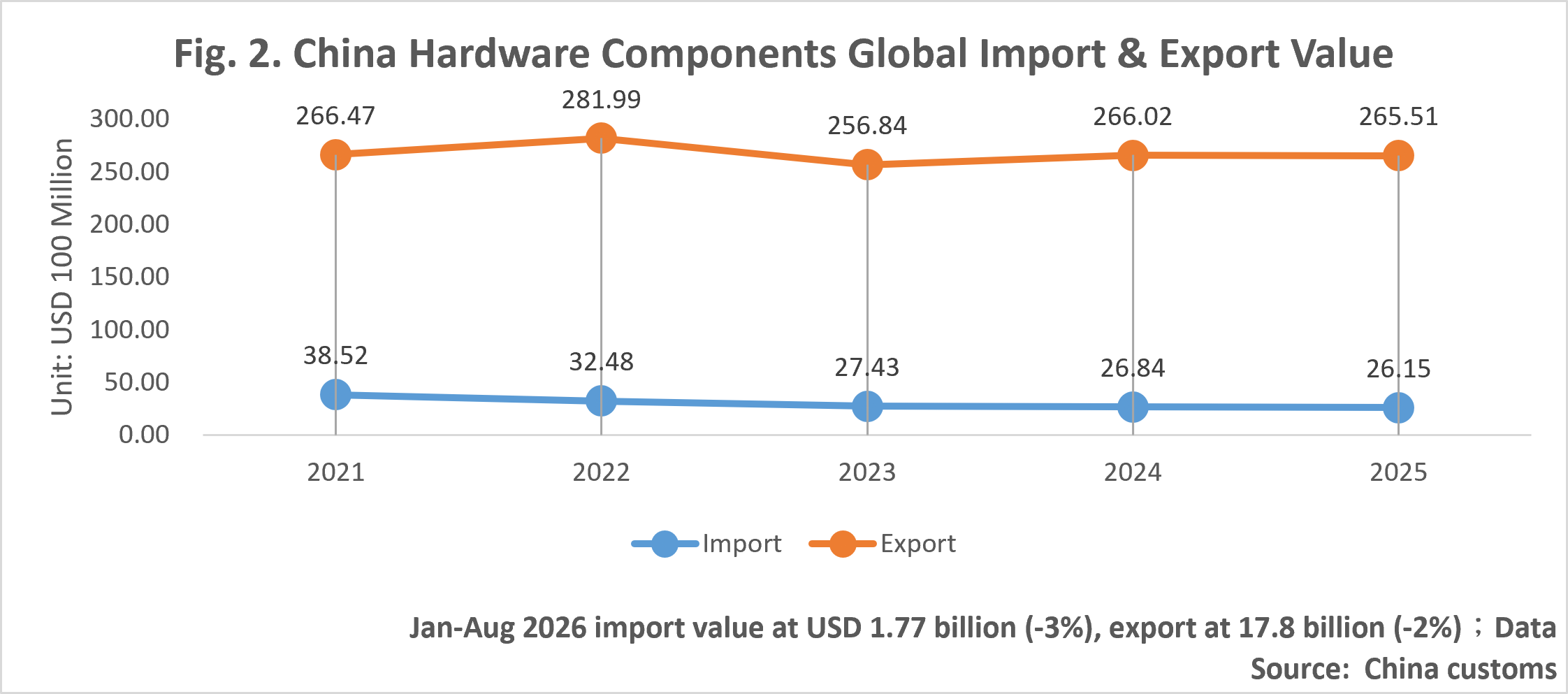
China is simultaneously a manufacturing base, an export base, and an upstream supplier to other manufacturing bases in Asia. From changes in hardware component trade between 2021 and 2025 (Figure 2), China has maintained substantial export capacity, serving not only domestic demand but also large manufacturing markets in Vietnam, Thailand, India and elsewhere in Asia. For HS 8302, for example, China’s exports to Vietnam reached approximately US$846 million in 2025, up 3.2% from US$820 million in 2024; hinge exports alone rose from about US$174 million to US$196 million, up 12.6%. This shows that even when some final-product manufacturing activities move outside China, Chinese hardware components can still “go overseas” with the supply chain.
The real change in China's hardware components industry is therefore the restructuring of manufacturing-base functions. Some companies continue to center their operations on large-scale manufacturing and exports from China, while others are beginning to establish new production nodes in Southeast Asia, India and Mexico in coordination with customers, creating hybrid models such as “Made in China + overseas assembly” or “Chinese supply + regional production.” This also explains why Chinese suppliers continue to have a strong presence in Southeast Asian hardware components import markets.
For Chinese suppliers, the next stage of competition is no longer simply about mass production. The key is whether they can convert their existing scale, cost advantages and comprehensive supply chain into high reliability, fast delivery, customization and regional supply capabilities required by automotive, electronics, energy, machinery, construction and emerging manufacturing industries. Therefore, the key questions for China's hardware market in 2026–2027 are which parts of manufacturing will remain in China, which will follow customers overseas, and whether Chinese suppliers can continue to control component supply chains for overseas manufacturing bases. China may no longer be the “world’s factory” in the future, but it may increasingly become the “component supply center behind the world’s factories.”
Taiwan: Traditional Hardware Components Are Being Repositioned Amid Soaring AI Exports
Taiwan is positioned at the core of global AI, semiconductor and advanced electronics manufacturing supply chains. At the same time, exports of traditional Taiwanese hardware components are undergoing a clear contraction. This is not simply a market decline; it is more accurately a redistribution of demand within Taiwan’s manufacturing sector. Taiwan's hardware component exports to the world fell from US$2.349 billion in 2021 to US$1.932 billion in 2025, a decline of about 17.7%, while imports rose from US$552 million to US$606 million, up about 9.7% (Figure 3).
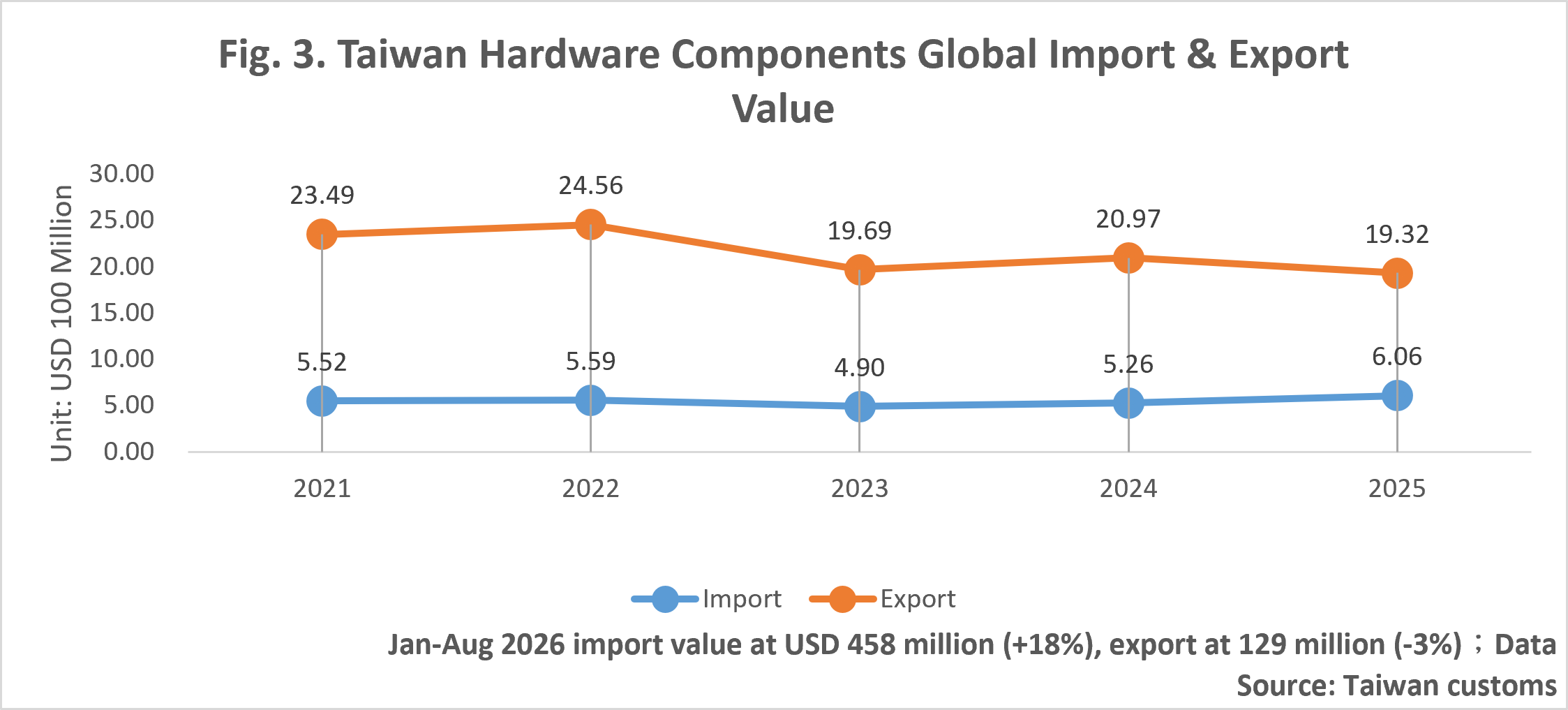
In 2025, the trade surplus between exports and imports narrowed from around US$1.570 billion to around US$1.325 billion, down about 18% over five years. Taiwan remains a net exporter of these products, but its traditional hardware component model, which relied heavily on overseas sales, is being reshaped. The issue for Taiwan is not a lack of export demand; rather, demand is shifting from traditional manufacturing toward AI and high-tech manufacturing.
HS 8302 and 8301 Remain the Two Pillars of Taiwan's Hardware Components Exports
Taiwan's hardware components have not lost competitiveness across the board; rather, performance varies considerably by product. HS 8302 brackets, fittings and similar products remain the largest export category. Exports reached US$631 million in 2025, accounting for about 48.9% of total exports of the 8 product categories; HS 8301 locks generated US$368 million in exports, or about a 28.6% share. Together, the two categories approached US$1 billion and accounted for approximately 77.5% of 2025 exports of the 8 categories. In other words, products supported by more comprehensive manufacturing capabilities, demanding quality requirements and established application markets continue to maintain substantial export scale. In addition, exports of HS 4016.93 sealing gaskets, washers and other seals still reached US$192 million in 2025, indicating that sealing and functional components retain an established international market base. Compared with standardized hardware, these products are more readily integrated into automotive, machinery, industrial equipment and energy applications where reliability requirements are higher.
Taiwan Is Moving from “Traditional Hardware Manufacturing” to “High-Value Components”
Rather than describing Taiwan's hardware components industry simply as being in decline, it is more precise to say that Taiwan is undergoing a reallocation of manufacturing resources. At one end, traditional products such as springs, steel wire products, locks, brackets and seals face declining export volumes amid global demand fluctuations, competition from lower-cost suppliers in China and Southeast Asia, and supply-chain adjustments by international customers. At the other end, demand related to semiconductor equipment, AI servers, electronic components, advanced packaging and high-end manufacturing equipment is increasing rapidly. If products can further enter semiconductor equipment, AI data centers, precision machinery, aerospace, energy equipment or high-end automotive supply chains, Taiwanese companies need to consider how to convert their existing capabilities in metalworking, precision forming, surface treatment, tooling, heat treatment and quality management into component capabilities required by high-tech industries—gradually transforming “general industrial consumables” into “high-specification, mission-critical components.” Taiwan's real target should be higher-value component positions.
Europe: Manufacturing Conditions Are Weak, but High-Value Hardware Components Still Have Room to Survive
EU hardware component imports (Figure 4) rose from US$8.777 billion in 2021 to US$9.127 billion in 2022, fell to US$8.143 billion in 2023, recovered to US$8.913 billion in 2024, and increased further to US$9.431 billion in 2025. Exports were US$12.477 billion in 2021, US$11.553 billion in 2022, US$11.520 billion in 2023, US$11.939 billion in 2024, and recovered to US$12.513 billion in 2025.
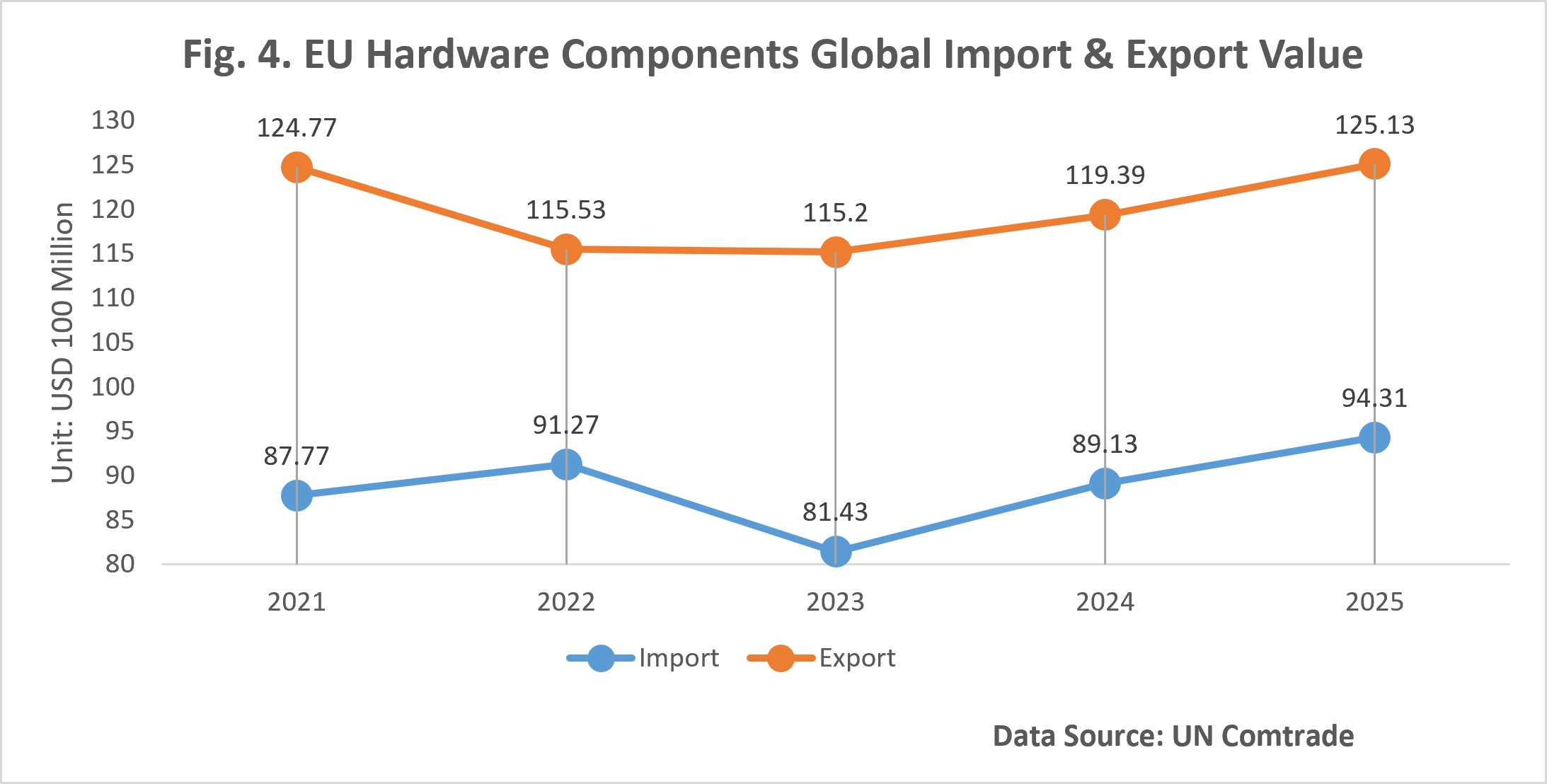
The EU has both substantial import demand and greater export capacity, indicating that its hardware component industry still has deep manufacturing and re-export capabilities. However, the cost pressures facing European manufacturing cannot be ignored. Würth Group, for example, recorded sales of €10.9 billion in the first half of 2026, up 4.3% year on year, while also pointing to rising energy prices, geopolitical uncertainty and weak industrial activity in Germany as ongoing pressures; Eastern Europe and South America, meanwhile, provided stronger growth momentum. SFS Group is also restructuring its global production and distribution network in 2026, explicitly seeking to concentrate production in fewer sites, reduce complexity and allocate resources to applications with greater differentiation and customer value, while maintaining a “local supply” strategy. This points to an important market signal: the next step for Europe’s hardware components industry may not be to expand capacity across all products, but to retain high-value manufacturing while moving some cost-sensitive products to more cost-competitive locations.
For standardized, heavy, low-unit-price and highly price-competitive hardware components—such as general-purpose hinges, brackets, standard springs and some commodity hardware—European manufacturers have an economic rationale for shifting part of production to Asia or other cost-competitive regions amid energy, labor and compliance pressures. By contrast, medical components, precision stampings and highly customized industrial components involve certification, quality risk, lead times and engineering services, giving Europe stronger incentives to retain manufacturing capacity for these higher-value-density products. Europe and Asia may therefore develop a new division of labor: Europe retains high-technology, highly certified and fast-response manufacturing; Asia handles large-volume and cost-sensitive parts; and European customers connect the two through local warehousing, technical services and supply-chain management. Suppliers will increasingly need to distinguish which products are worth producing locally in Europe and which are better sourced from Asia.
Japan's Market Is Mature, but “Lower Volume, Higher Value” Deserves Attention
Figure 5 shows that Japan's hardware component imports were US$1.829 billion in 2021, US$1.843 billion in 2022, US$1.790 billion in 2023, US$1.729 billion in 2024, and recovered to US$1.782 billion in 2025. Exports fell from US$2.026 billion in 2021 to US$1.654 billion in 2023, stood at US$1.655 billion in 2024, and US$1.653 billion in 2025. In terms of weight, Japan's imports declined steadily from about 232,700 tons in 2021 to 202,000 tons in 2025, while export volume fell from 89,500 tons to 80,100 tons.
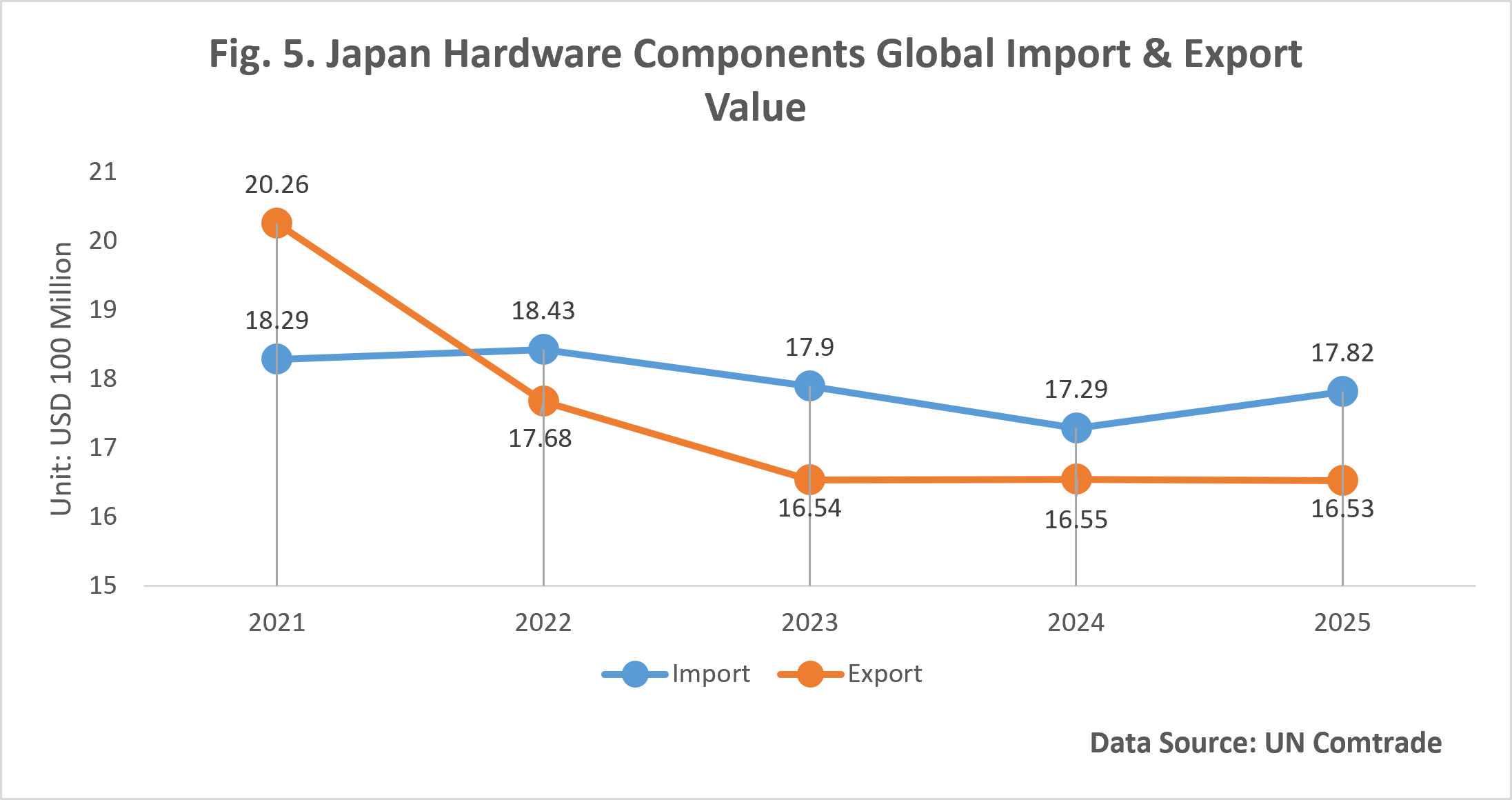
Japan shows declining weight but relatively stable value. When manufacturers are no longer increasing volumes of standardized products but continue to demand greater precision, lighter weight, higher reliability and special specifications, volume does not necessarily rise while the value of hardware components can remain stable. Japan’s automotive market shows a similar pattern. According to the International Organization of Motor Vehicle Manufacturers, sales of all types of new vehicles in Japan reached about 4.566 million units in 2025, up 3.3% from 2024 but still below the 5.195 million units recorded in 2019. Japan is therefore not a typical “volume-growth market,” but rather a mature-demand, high-specification-manufacturing and equipment-upgrade market.
India Is a Dual Engine of “Demand + Manufacturing” Worth Watching Long Term
India's GDP growth rate was about 7.6% in 2025, relatively strong among major large economies, while net foreign direct investment inflows were approximately US$39.1 billion. Hardware component trade also expanded (Figure 6): imports rose from US$1.204 billion in 2021 to US$1.458 billion in 2025, while exports increased from US$945 million to US$1.009 billion. More importantly, India’s exports also increased during 2021–2025, indicating that the country is gradually developing a dual role as both a demand market and a manufacturing base.
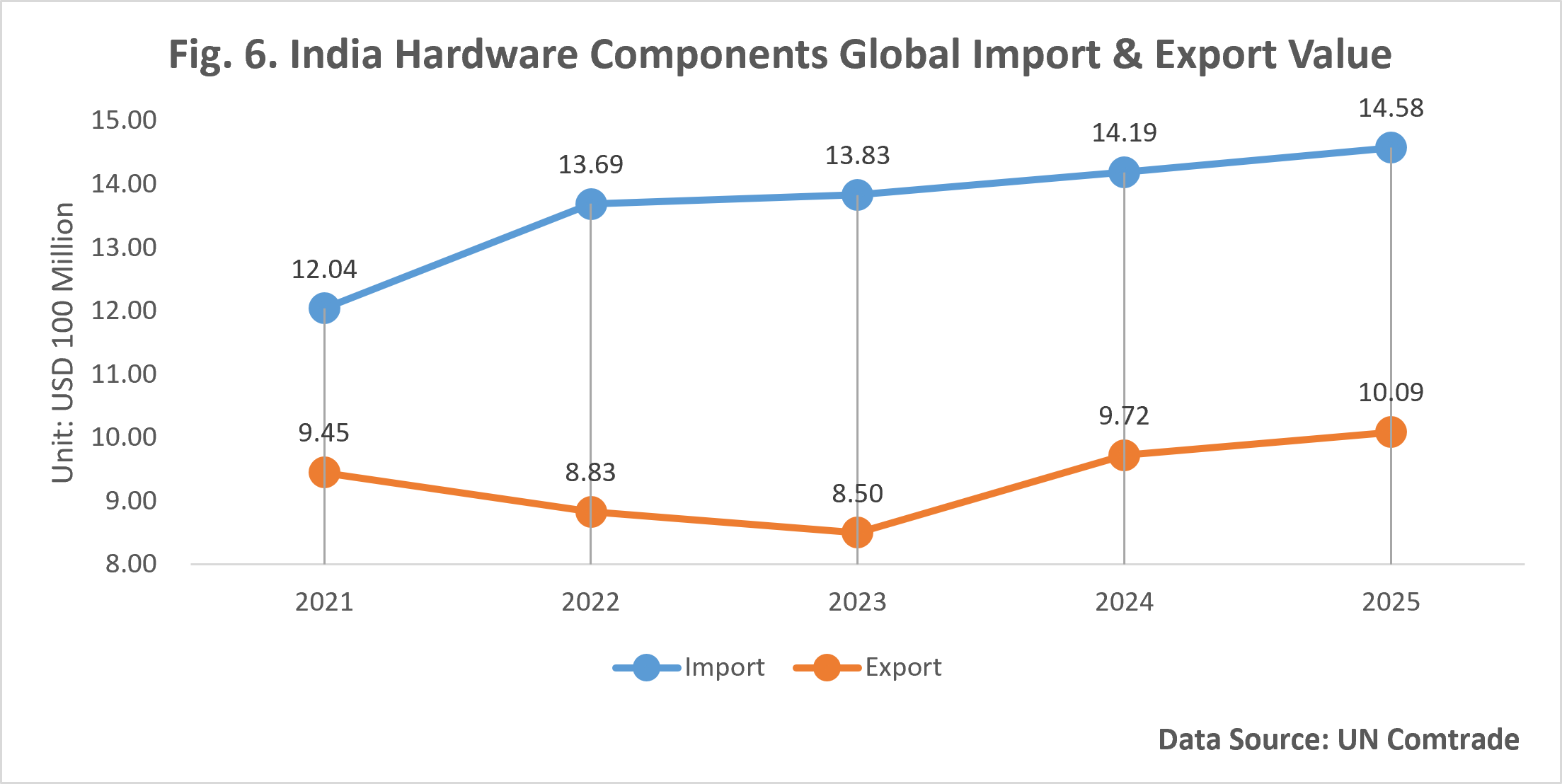
India's growth story follows a clear sequence: population growth → urbanization → infrastructure expansion → factory investment → rising vehicle use → machinery and equipment growth → more hardware component demand. According to the International Organization of Motor Vehicle Manufacturers, sales of all types of vehicles in India reached about 5.518 million units in 2025, up 5.5% from 2024 and 44.6% above 2019. This indicates that India is not simply a mature replacement market; new demand and the establishment of manufacturing capacity are occurring simultaneously across relevant industries.
ASEAN's Opportunity Is Not “Low Cost,” but Its Role as a Supply Chain Node
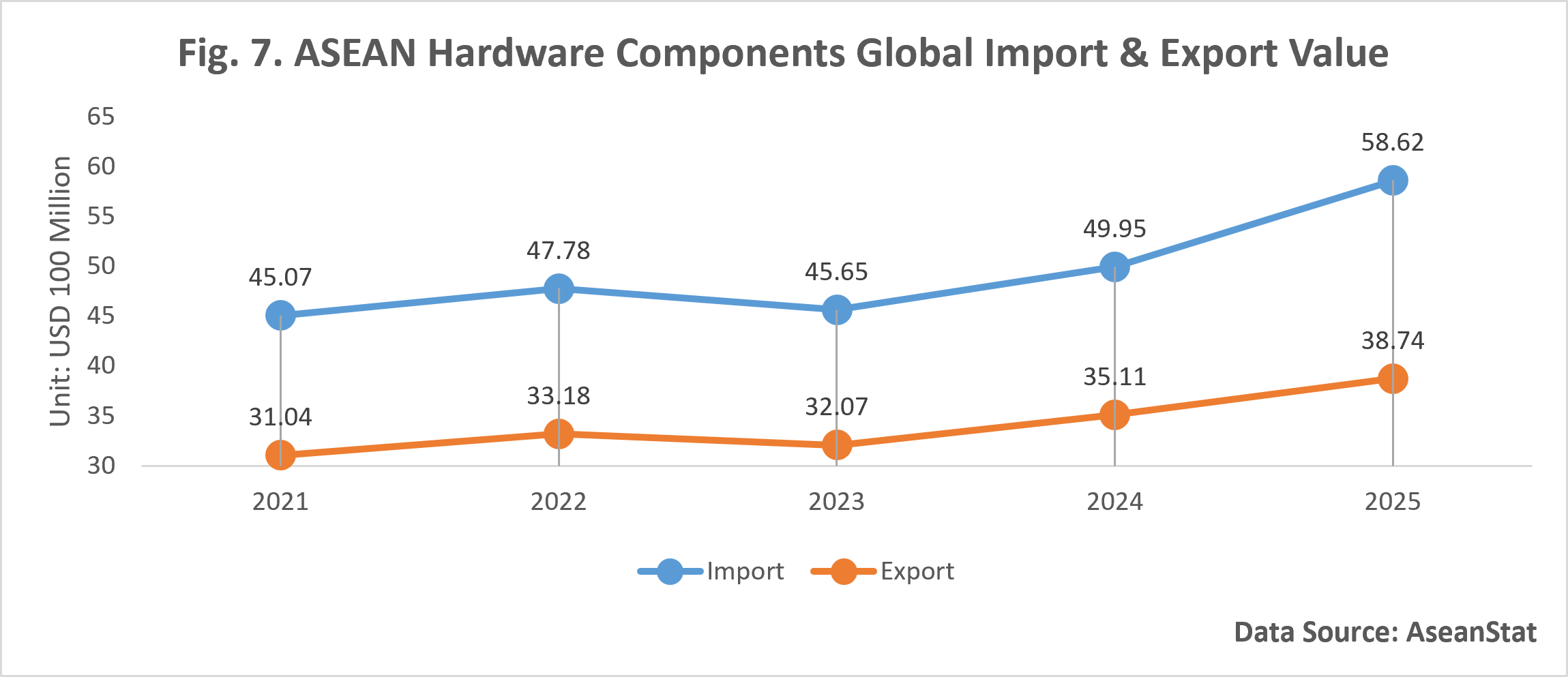
Southeast Asia is becoming an important node in the restructuring of the global hardware component supply chain, and its role is no longer defined simply by the traditional advantage of low-cost manufacturing. Trade data (Figure 7) show that ASEAN's role is expanding toward both ends of the spectrum—as a production base and as a demand market. ASEAN exports to the world rose from US$3.104 billion in 2021 to US$3.874 billion in 2025, a 5-year increase of about 24.8%; imports rose much more sharply from US$4.507 billion to US$5.862 billion, up about 30.1%. The expansion of the ASEAN hardware component market has therefore been faster on the import side. The demand for hardware component imports, reaching as high as US$5.862 billion, also indicates significant scope for external sourcing within the supply chain.
This change is important. In 2025, ASEAN's global import plus export trade in the hardware components covered above reached US$9.736 billion, up about 27.9% from US$7.611 billion in 2021.Meanwhile, the trade deficit widened from US$1.403 billion to US$1.988 billion. This does not simply indicate a lack of manufacturing capability in ASEAN; it can instead be interpreted as evidence that expansion of local manufacturing, factory investment and supply-chain localization are creating greater component demand. In other words, when companies move production capacity to Vietnam, Thailand, Malaysia and Indonesia, they need not only local low-cost labor but also a complete supply system for springs, hardware fittings, mechanical parts and other industrial components.
The significance of Southeast Asia to the global market is therefore changing. It is no longer simply a destination to which factories are moved; it is becoming an intermediate supply-chain hub connecting China, Taiwan, Japan, South Korea, Europe and the U.S. For hardware component suppliers, the advantage of Southeast Asia is not merely the pursuit of the lowest production cost, but access to emerging manufacturing clusters and local supply opportunities in automotive, electronics, machinery, furniture, home appliances and infrastructure. Companies that can establish stable local inventories, lead times, quality certifications, technical services and customer relationships are more likely to become part of the supply chain. For Taiwanese companies, the value of ASEAN is not merely to “diversify China production risk,” but potentially to transform from simple exporters into participants in regional supply-chain networks.
Thailand is Automotive and Industrial Manufacturing Oriented
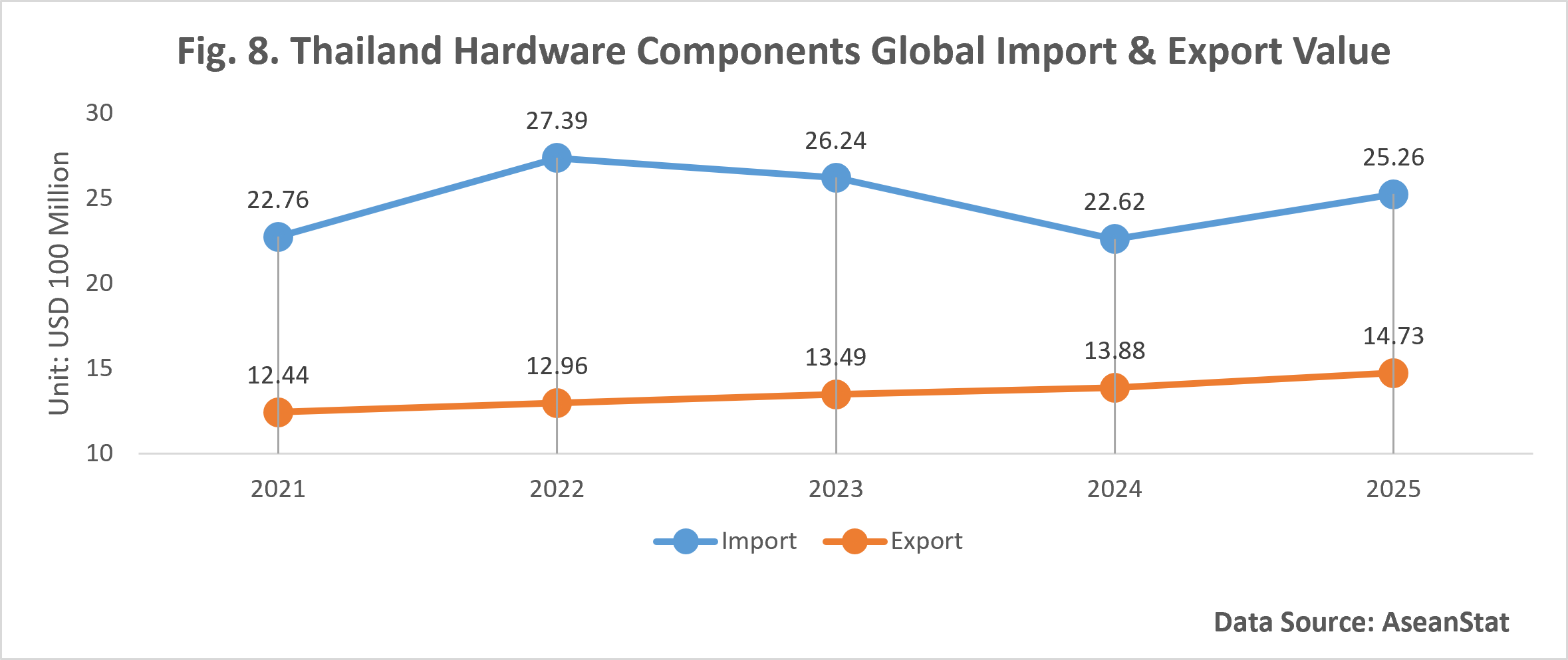
Thailand has long maintained comprehensive automotive, machinery, home-appliance and electronics clusters, so demand for hardware components comes not only from newly established factories but also from an industrial ecosystem that has operated for many years. Thailand's hardware component exports to the world (Figure 8) rose from US$1.244 billion in 2021 to US$1.473 billion in 2025, up about 18.4%; imports increased from US$2.276 billion to US$2.526 billion, remaining above exports, with 2025 imports about 1.7 times exports. Thailand is not merely manufacturing hardware components for re-export; it is also a manufacturing market with substantial demand for imported components. Thai manufacturers continue to source large quantities of hardware, mechanical parts and industrial components from overseas and integrate them into automotive, machinery, electronics, home appliances and other production systems. For suppliers, this means sustained B2B component demand rather than a one-time factory-building opportunity. Suppliers that can enter local OEM, Tier 1 & 2 and industrial equipment supply chains can access long-term, recurring component demand.
Indonesia is Population and Domestic-Demand Driven
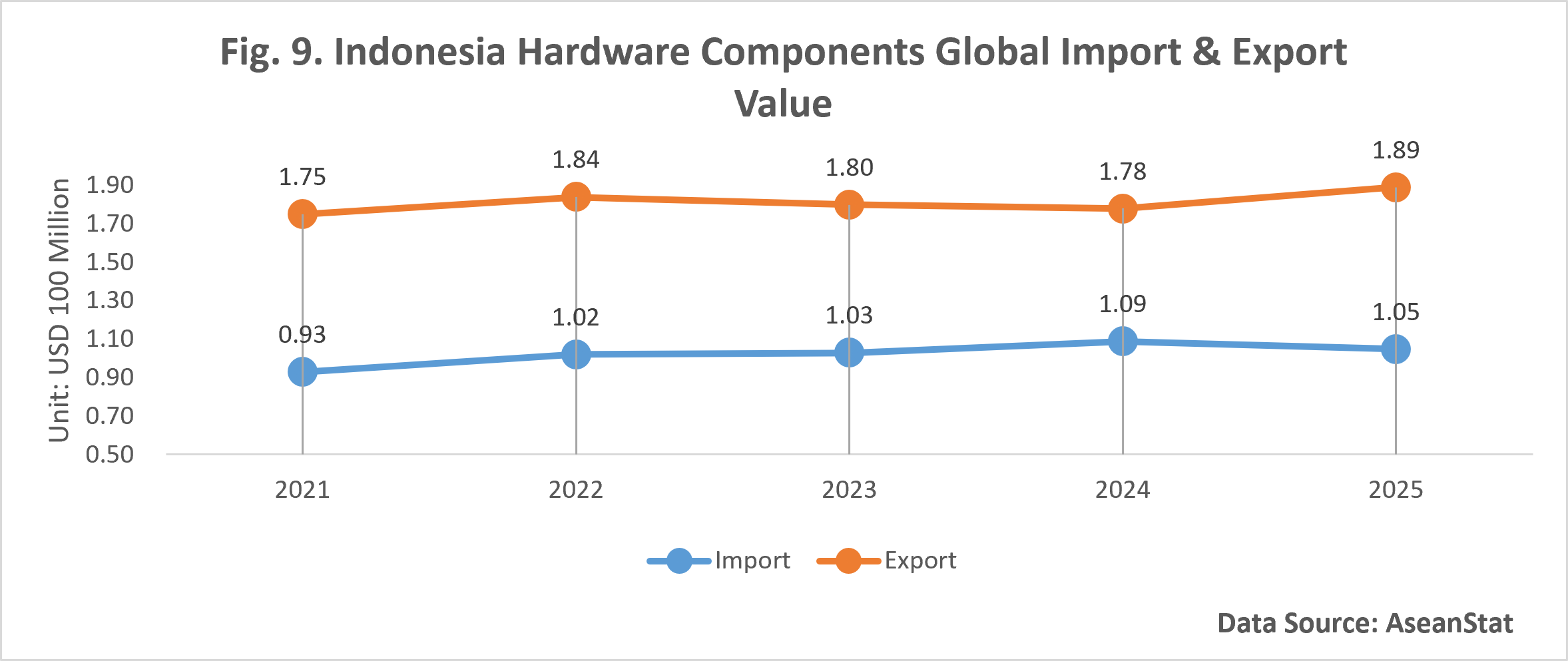
Indonesia's defining feature is not export orientation but a domestic market created by its large population, urbanization and manufacturing expansion. Indonesia’s global import plus export trade in hardware components increased from US$268 million in 2021 to US$294 million in 2025, a five-year increase of about 9.7%; exports rose from US$175 million to US$189 million, up about 7.7%, while imports increased from US$93.48 million to US$105 million, up about 12.5%. Indonesia is not only a hardware component production market; it is also generating growing import demand.
In 2021 (Figure 9), Indonesia's exports were about 1.88 times imports, but by 2024 the ratio had fallen to about 1.63, indicating that import demand was growing faster than exports. In 2025, exports recovered to US$189 million, and the trade surplus widened from about US$69.75 million in 2024 to US$83.37 million, although it remained below the US$81.62–81.99 million levels recorded in 2021–2022. This indicates that Indonesia’s market is gradually shifting from a pure export supply base toward a structure combining “local manufacturing + import supplementation + domestic consumption.” This change is consistent with Indonesia’s recent investment direction. In 2025, Indonesia’s realized investment reached IDR 1,931.2 trillion, a year-on-year increase of 12.7%. Investment in industries related to "basic metals, metal products, and non-machinery/equipment" totaled IDR 262 trillion—accounting for 13.6% of the total—making it a key investment sector. That same year, the manufacturing sector grew by 5.3%, while the machinery and equipment industry expanded by 13.98%, signaling growing demand for industrial equipment, metal products, and related components.
Demand for hardware components in Indonesia can therefore be understood as a three-layer market: “population-driven domestic demand + manufacturing upgrade + infrastructure and urbanization.” For suppliers, Indonesia’s importance does not primarily come from how much it can export, but from the fact that it is becoming one of Southeast Asia’s markets with a huge end-consumer population, manufacturing investment and component import demand—turning its demographic dividend into a “dual-engine market of domestic demand and manufacturing” for hardware components.
Latin America: Large Demand Markets Still Rely on Overseas Supply
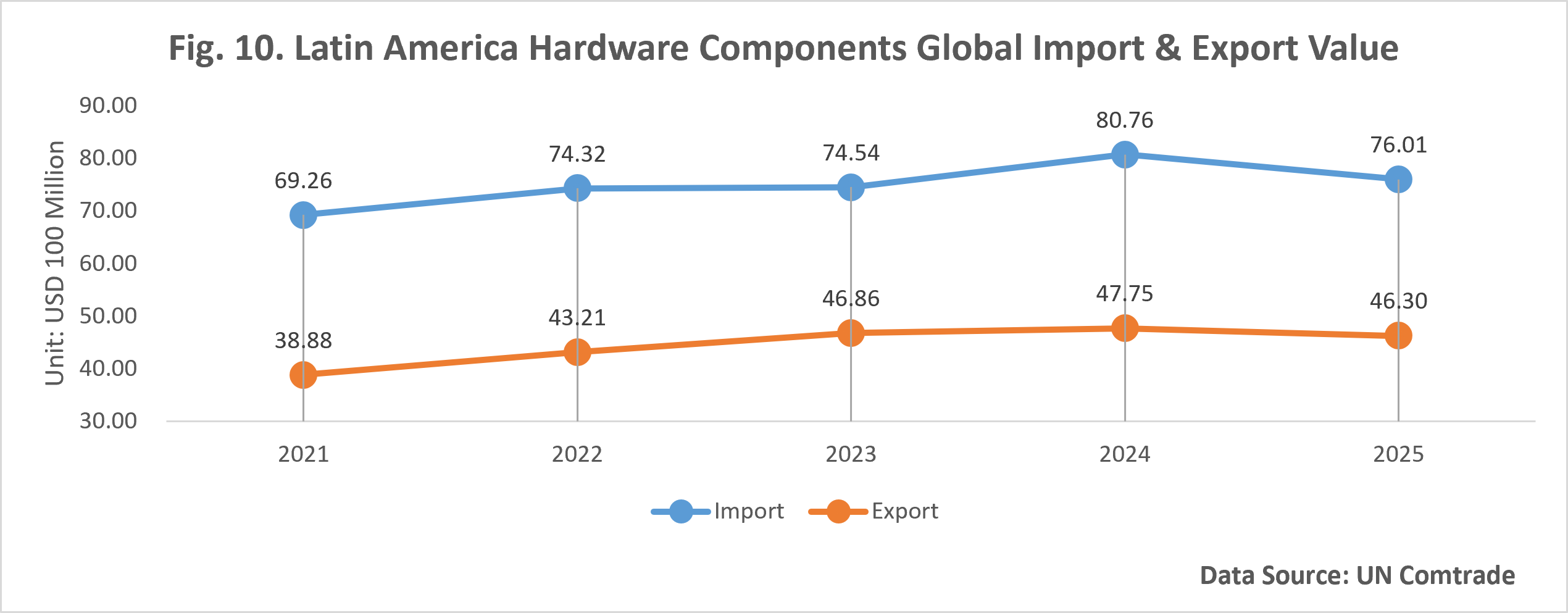
Latin America's global import plus export trade in hardware components fell to US$12.231 billion in 2025, but was still about 13.1% higher than the US$10.815 billion recorded in 2021. Imports remained higher than exports throughout the period (Figure 10), with imports rising from US$6.926 billion in 2021 to US$7.601 billion in 2025, while exports increased from US$3.888 billion to US$4.630 billion. Over the 5-year period, imports increased about 9.7% and exports about 19.1%, indicating that Latin America's export capability is improving, but import demand remains larger. This region is not without manufacturing capability; rather, overall supply remains insufficient to fully meet local demand, leaving overseas suppliers with an important role.
Mexico: Domestic Demand and Exports Expanding in Parallel
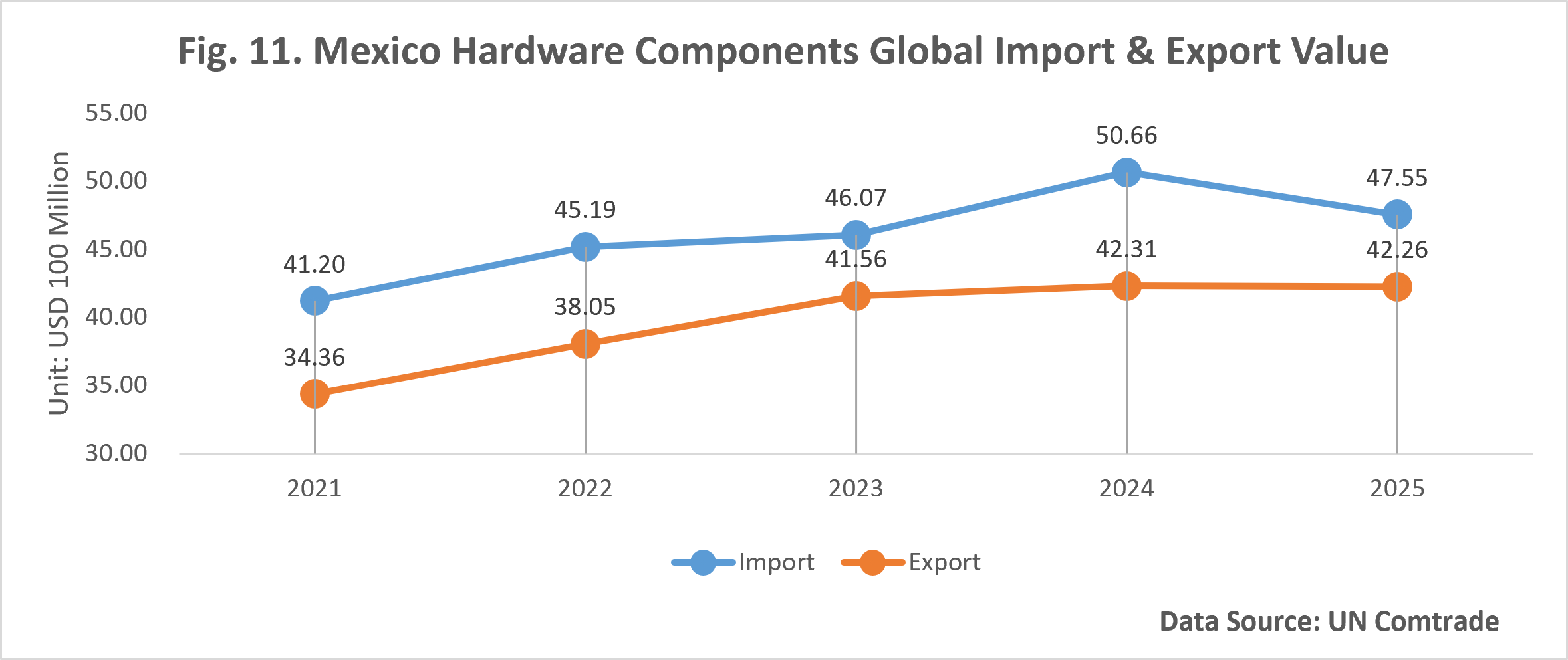
Mexico's global hardware component imports (Figure 11) rose from US$4.120 billion in 2021 to US$4.755 billion in 2025, up about 15.4% over 5 years; exports rose from US$3.436 billion to US$4.226 billion, up about 23.0%. Mexico’s market is clearly expanding. It is not simply an import-dependent market serving domestic demand; it is also increasing its own export capacity. Mexico recorded a trade deficit in hardware components in each of the 5 years, but the deficit did not continuously widen: it was about US$684 million in 2021 and narrowed to US$529 million in 2025. Export coverage of imports also increased from 83.4% in 2021 to 88.9% in 2025, indicating that Mexico is simultaneously importing large quantities of components to support manufacturing while increasing domestic production and export capability.
This is consistent with Mexico's established automotive, electronics, home-appliance, aerospace and machinery manufacturing clusters. In 2024, Mexico's automotive component exports were approximately US$106 billion, and the country had more than 2,100 automotive component companies; northern Mexico, the Bajío and other manufacturing clusters have developed Tier 1–3 supplier networks. Nearshoring therefore brings not only “more factories” but also sustained demand for hardware components. Mexico is shifting from “a production base close to the U.S.” toward “a major component demand center and manufacturing export platform within the North American supply chain.” As automotive, electronics, home appliances and industrial equipment continue to expand production in Mexico, the key issues to watch are which components will move with these supply chains and which products will gradually shift from imports to local Mexican production.
Middle East: Engineering-Driven Demand Is Moving from Large Construction Projects to High-Specification Components
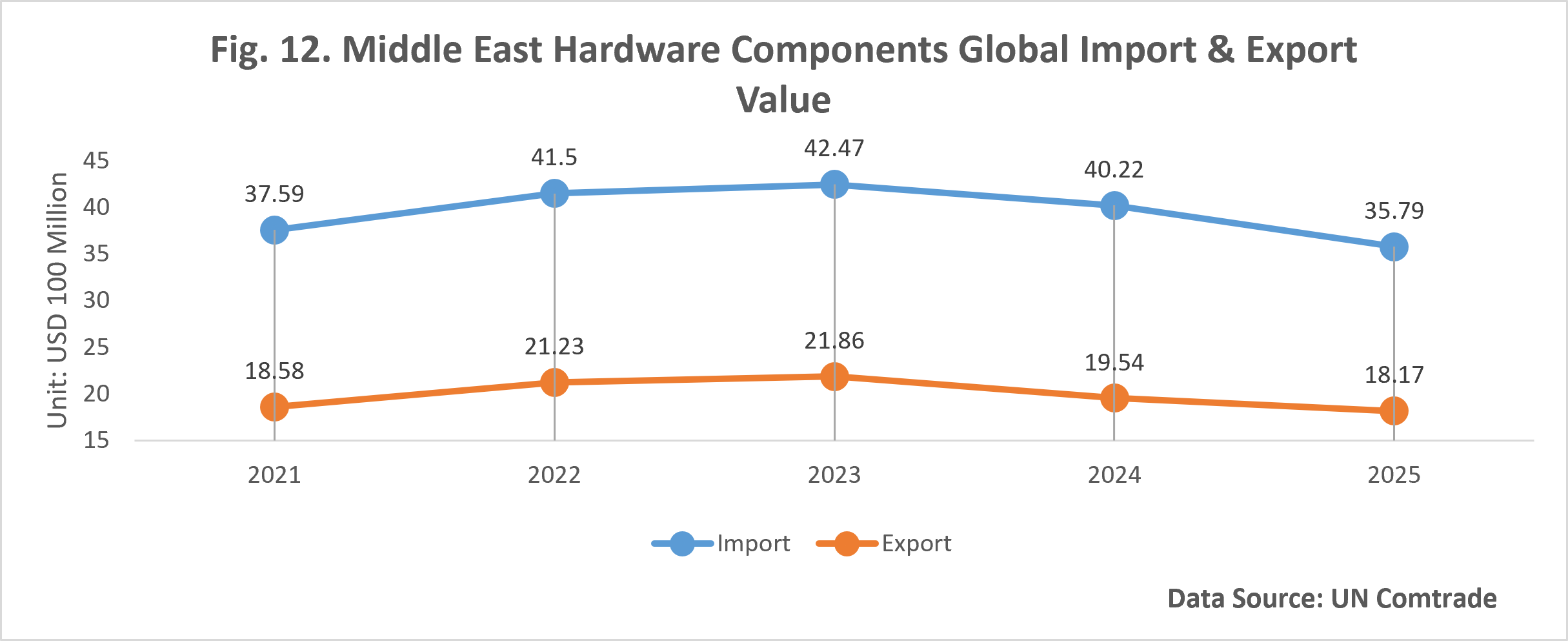
The defining feature of the Middle East hardware component market is not the scale of traditional manufacturing, but the “engineering-driven demand” generated by large projects, infrastructure, energy transition, urban development and high-end commercial construction. Middle Eastern hardware component imports (Figure 12) were US$3.759 billion in 2021 and remained at US$3.579 billion in 2025. Exports fell from US$1.858 billion in 2021 to US$1.817 billion in 2025. Although the 2025 market size was below the 2023 peak, imports remained close to twice exports, showing that the region continues to have a clear net-import profile for hardware components.
Saudi Arabia's hardware component imports, for example, rose from US$621 million in 2021 to US$962 million in 2025, up about 55% in 4 years, indicating relatively stable component demand generated by large infrastructure projects, housing, commercial development and industrial investment. Saudi Arabia is also promoting local manufacturing through Vision 2030 and has proposed developing local manufacturing capabilities in building hardware and fittings, water pumps and electrical components to reduce reliance on imports. Large projects in Saudi Arabia and the UAE continue to cover transportation, housing, energy, tourism, data centers and smart cities. Approximately US$951 billion worth of projects are currently under execution in the Gulf region, indicating that demand is supported not simply by a short-term construction boom but by large, long-term investment programs. The Middle East is notable because large projects are shifting hardware demand from simple component procurement toward high-specification, customized, system-level packages and long-term supply. This demand profile also offers potential points of alignment with Taiwan’s hardware component processing capabilities.
Global Hardware Component Supply Chain & Reordering of Product Value
The U.S. remains a huge end-demand market, while the Middle East is driven by large projects and energy investment, and India, Thailand and Mexico are gradually becoming new manufacturing and supply-chain nodes. The global supply chain, once relatively clear in terms of “where products are made and where they are sold,” is now becoming a more complex 3-layer structure in which production bases, regional manufacturing nodes and final demand markets are being recombined.
全球
五金零組件
市場
彈簧
支架
密封件
扣件
國際展會
惠達雜誌
匯達實業
外銷媒合
廣告刊登
螺絲五金
五金工具
緊固件
台灣扣件展
印度新德里螺絲展
越南河內螺絲展
墨西哥瓜達拉哈拉螺絲展
美國拉斯維加斯螺絲暨機械設備展
2027美國鳳凰城螺絲暨機械設備展
波蘭克拉科夫螺絲展
義大利米蘭螺絲展
德國司徒加特螺絲展
德國杜塞道夫線材展
Fastener
Hand Tool
Hardware
Component
Fastener World
Wire Dusseldorf
Fastener Fair India
Fastener Fair Vietnam
Fastener Fair Mexico
Fastener Poland
Fastener Fair Italy
IFE
Fastener Fair Global
2027
Global Hardware
Components
Market
Springs
fittings
sealing products